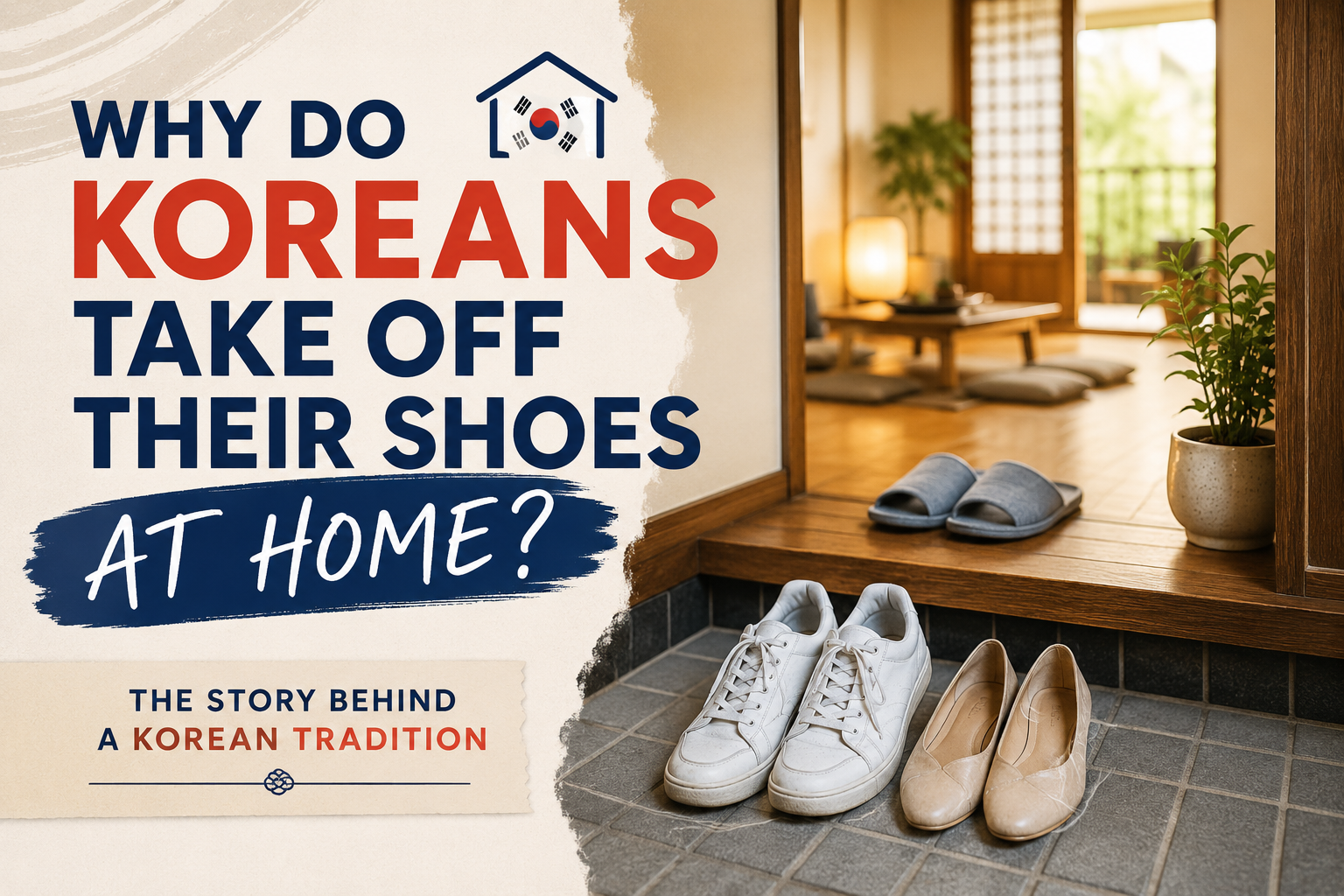
If you visit a Korean home for the first time, you may notice something immediately: shoes usually stay at the door.
For many Koreans, taking off shoes before entering the home is such a natural part of everyday life that it rarely requires explanation. But for visitors from countries where wearing shoes indoors is common, the custom can seem surprising.
Why do Koreans take off their shoes at home?
The answer is more interesting than simply saying, “It keeps the floor clean.” The tradition is connected to Korean home culture, the traditional ondol heating system, hygiene, and the way people use their living spaces.
Shoes Stay at the Door
In a typical Korean home, the entrance often has a small area where people remove their outdoor shoes before stepping into the main living space.
You may see several pairs of slippers, indoor shoes, or simply socks and bare feet.
This creates a clear boundary between the outside world and the home.
Outdoor shoes can carry dirt, dust, rain, and other things from streets and public spaces. Removing them at the entrance helps keep the interior cleaner, especially in homes where people spend a lot of time sitting or relaxing close to the floor.
But cleanliness is only part of the story.
The Role of Ondol in Korean Homes
One of the biggest historical reasons behind Korea’s indoor shoe culture is ondol, Korea’s traditional floor-heating system.
Ondol has been used in Korea for centuries. Traditionally, heat from a fire was transferred through channels beneath the floor, warming the surface from below.
This was more than a way to heat a room. It influenced how Koreans used their homes.
Instead of relying primarily on chairs and beds, people traditionally spent significant amounts of time sitting, eating, resting, and even sleeping on or near the floor.
When the floor itself becomes part of the living space, keeping it clean becomes much more important.
This helps explain why removing outdoor shoes became deeply connected with Korean household culture.
The Floor Is Part of the Living Space
Modern Korean homes are different from traditional homes, but the cultural influence remains.
Korean families today may have sofas, dining tables, beds, and desks just like families elsewhere. However, floor-based activities are still common.
People may sit on the floor while watching television, eat around a low table, play with children, or relax on floor cushions.
Because the floor is still an important living surface, wearing outdoor shoes indoors can feel uncomfortable or even inappropriate.
For many Koreans, the expectation is simple:
Outside shoes belong outside. Indoor spaces are kept separate.
Is It About Hygiene?
Yes, but not only hygiene.
Taking off shoes reduces the amount of dirt and outdoor debris brought into the home. This can be especially noticeable during Korea’s rainy or snowy seasons, when shoes can bring water and mud indoors.
However, it would be inaccurate to say that Koreans remove their shoes only because they are more concerned about cleanliness than people in other countries.
Different cultures develop different household habits based on their architecture, climate, traditions, and lifestyle.
In Korea, the combination of floor-centered living and traditional heating helped make the shoe-free home a deeply familiar practice.
What Should Foreign Visitors Do?
If you are invited to a Korean home, the safest approach is simple:
Look at the entrance.
If you see shoes lined up near the door, take yours off.
In some homes, the entrance may have a slightly lowered area called a hyeon-gwan, where outdoor shoes are removed before entering the main interior.
You may also be offered indoor slippers.
If you are unsure, there is nothing wrong with asking:
“Should I take my shoes off?”
Your host will understand.
In fact, making the effort to follow the household custom is generally considered a polite gesture.
What About Restaurants and Other Places?
The shoe-removal custom is not limited to private homes.
Some traditional Korean restaurants, restaurants with floor seating, guesthouses, and certain cultural spaces may also require visitors to remove their shoes.
However, not every Korean restaurant or business follows this practice.
Modern restaurants generally use tables and chairs and allow customers to keep their shoes on.
So if you visit Korea, don’t assume that you need to remove your shoes everywhere. Look for signs, observe what other customers are doing, or ask staff.
Do Koreans Wear Slippers Indoors?
Many Korean households use indoor slippers, especially in apartments.
Others simply walk around in socks or barefoot.
The choice depends on the household, season, flooring, and personal preference.
In winter, indoor slippers can be particularly comfortable because they provide warmth without bringing outdoor dirt into the home.
This distinction between outdoor shoes and indoor footwear is an important part of modern Korean home life.
More Than a Rule: A Different Way of Seeing the Home
Perhaps the most interesting part of the tradition is that removing shoes is not usually thought of as a complicated rule.
It is simply part of what makes a home feel like a home.
The entrance becomes a transition point between the outside world and private space.
You leave behind the dirt, noise, and activity of the street and enter a space where you can relax.
For someone visiting Korea for the first time, this small habit can reveal something much bigger about Korean culture.
It shows how architecture, heating technology, cleanliness, family life, and cultural traditions can influence everyday behavior.
Why This Korean Tradition Still Matters Today
Korea has changed dramatically over the past century.
Traditional houses have increasingly been replaced by modern apartments. Families have adopted new lifestyles, technologies, and furniture. Yet the habit of taking off outdoor shoes remains common.
That is because traditions do not always survive simply because people consciously decide to preserve them.
Sometimes they survive because they continue to make sense in everyday life.
For many Koreans, taking off shoes is simply the natural way to enter a home.
And for visitors, it is one of the easiest ways to experience a small but meaningful part of Korean culture.
Final Thought
The next time you see a row of shoes at the entrance of a Korean home, remember that it is more than a cleanliness rule.
It reflects a long connection between Korean homes, ondol floor heating, floor-based living, and the cultural idea of separating the outside from the private space of the home.
So if you are visiting Korea or are invited into a Korean home, there’s one simple rule to remember:
When in doubt, look at the shoes by the door.
That small gesture can be your first step toward understanding everyday life in Korea.