Have you ever looked at a jar of Korean kimchi and wondered how people actually make it at home?
If you’ve never made kimchi before, the process might seem a little intimidating.
There is cabbage to prepare, vegetables to season, red pepper flakes to mix, and then there is the whole idea of fermentation.
But don’t worry.
Making kimchi at home can actually be much simpler than it looks.
Today, we’re going to make two very different styles of Korean kimchi.
First, we’ll make Geotjeori, a fresh kimchi that you can enjoy almost immediately.
Then we’ll take a look at Kimjang-style kimchi, the traditional Korean kimchi made for fermentation and longer storage.
The two may look similar at first, but the experience is quite different.
One is fresh, crunchy, and ready to eat.
The other changes gradually over time, becoming more sour and complex as it ferments.
So, let’s step into the Korean kitchen and make some kimchi.
First, What Is Geotjeori?
If you’ve never made kimchi before, Geotjeori is a great place to start.
Geotjeori is a type of fresh kimchi that is generally eaten shortly after it is prepared rather than being fermented for a long period.
Because it is fresh, the cabbage remains crisp and juicy.
The flavor is spicy, savory, slightly sweet, and refreshing, without the strong sourness that develops in well-fermented kimchi.
In Korea, Geotjeori is often served as a fresh side dish with rice, meat, or noodles.
It is especially delicious when paired with grilled pork.
The fresh and spicy cabbage provides a nice contrast to the richness of the meat.
And the best part?
You don’t have to wait for fermentation.
Once you’ve finished making it, you can sit down and eat it.
Ingredients for Fresh Geotjeori
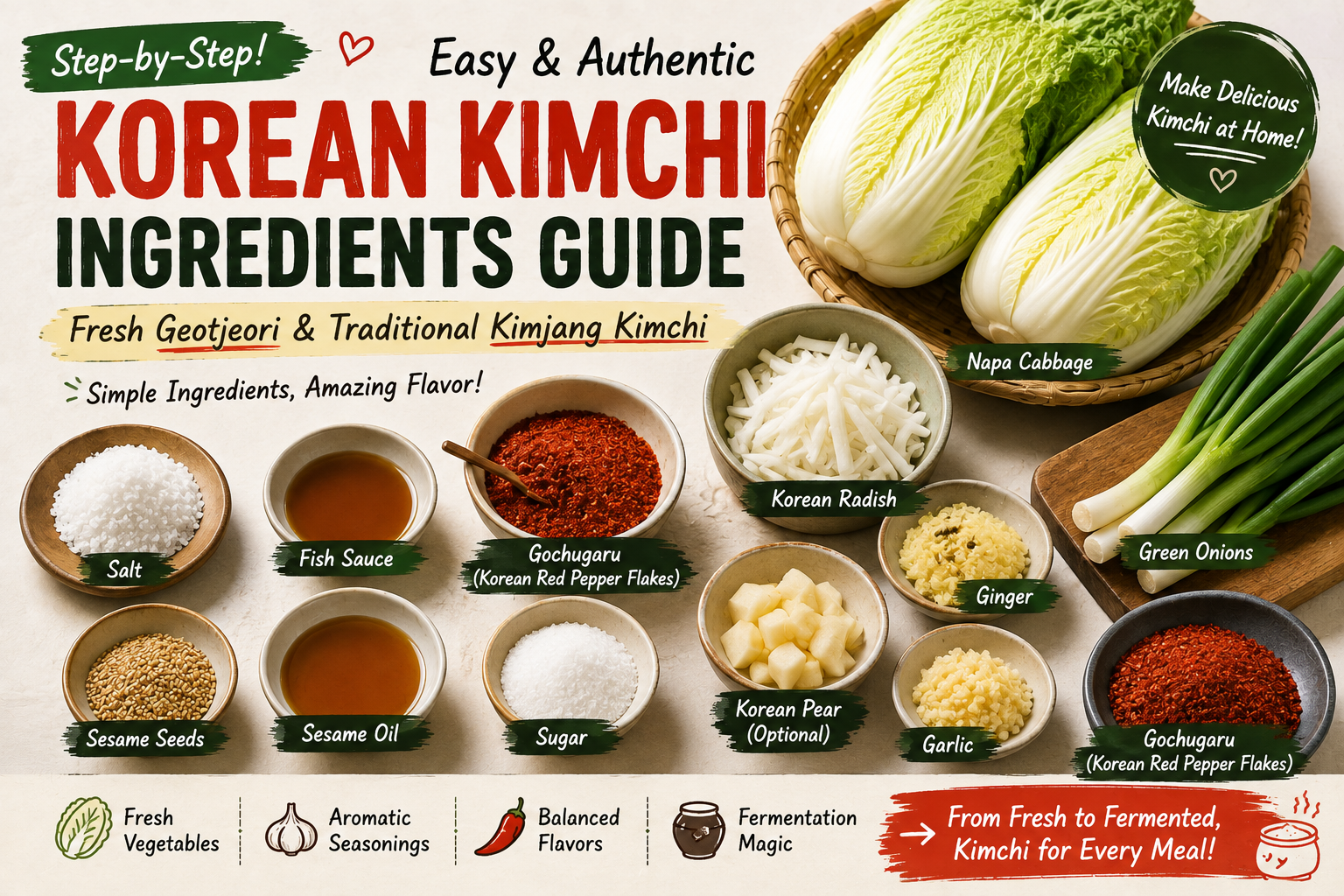
For approximately four servings, you’ll need:
1 small napa cabbage
2 tablespoons Korean red pepper flakes, or gochugaru
1 tablespoon fish sauce
1 tablespoon minced garlic
1 teaspoon grated ginger
1 teaspoon sugar
2 green onions
1 tablespoon sesame seeds
1 tablespoon sesame oil
Salt
The amount of gochugaru can easily be adjusted.
If you’re new to Korean food or don’t enjoy very spicy food, start with a smaller amount.
You can always add more.
Step 1: Prepare the Napa Cabbage
Cut the napa cabbage into bite-sized pieces.
They don’t have to be perfectly identical.
That’s one of the nice things about making kimchi at home.
It doesn’t have to look like it came from a restaurant kitchen.
Place the cabbage in a large bowl and sprinkle it with salt.
Let it sit for about 20 to 30 minutes.
The salt draws some moisture out of the cabbage and changes its texture slightly, making it easier to season.
Afterward, rinse the cabbage thoroughly with cold water and drain it well.
You don’t want excess water sitting in the bowl.
Step 2: Make the Kimchi Seasoning
In a separate bowl, combine:
Gochugaru
Fish sauce
Minced garlic
Grated ginger
Sugar
Mix everything together until you have a thick, flavorful seasoning.
This is usually the moment when the kitchen starts smelling like Korean food.
The combination of garlic, ginger, and Korean red pepper creates one of the most recognizable aromas in Korean cooking.
Step 3: Mix the Kimchi
Add the drained cabbage to the seasoning.
Add the chopped green onions and gently mix everything together.
If you want to make the experience feel a little more traditional, use food-safe kitchen gloves and mix the seasoning into the cabbage with your hands.
This allows you to coat the cabbage evenly without crushing it.
Finally, add sesame oil and sesame seeds.
Give everything one last gentle mix.
And that’s it.
Your fresh Geotjeori is ready to eat.
What Does Geotjeori Taste Like?
Geotjeori tastes very different from older fermented kimchi.
The cabbage is still crisp and fresh, and the flavor is brighter.
You’ll notice the heat from the gochugaru, the savory flavor from the seasoning, the aroma of garlic and ginger, and a slight nuttiness from sesame oil and sesame seeds.
Because it isn’t aged for a long fermentation period, it doesn’t have the strong sour flavor associated with mature kimchi.
For someone trying Korean kimchi for the first time, this can be a very approachable introduction.
What Should You Eat With Geotjeori?
Fresh Geotjeori pairs especially well with rich or savory foods.
Try it with:
Grilled pork
Korean barbecue
Steamed rice
Boiled pork
Grilled beef
Korean noodles
One classic combination is boiled pork with fresh kimchi.
The rich pork and crisp, spicy cabbage complement each other surprisingly well.
It’s a simple combination, but once you try it, you’ll understand why fresh kimchi is such an important part of Korean meals.
Is Geotjeori Healthy?
Because Geotjeori is primarily made from vegetables, it can contribute dietary fiber, vitamins, minerals, and various plant compounds to a meal.
However, there is an important difference between Geotjeori and fermented kimchi.
Geotjeori is generally eaten fresh and does not go through the same fermentation process as kimchi that has been stored for a longer period.
That means you shouldn’t automatically assume that fresh Geotjeori has the same microbial characteristics as fermented kimchi.
This distinction is important when discussing the nutritional properties of kimchi.
Fresh and fermented kimchi are related, but they are not exactly the same food from a fermentation perspective.
Now Let’s Make Traditional Kimjang-Style Kimchi
If Geotjeori is the fresh and easy version, Kimjang-style kimchi represents something much deeper in Korean food culture.
Kimjang refers to the traditional practice of preparing and sharing kimchi, historically in large quantities before winter.
For generations, Korean families and communities gathered together to prepare large batches of kimchi.
It wasn’t simply a cooking project.
It was a time for families and neighbors to work together, share food, exchange recipes, and pass cooking knowledge from one generation to the next.
In 2013, UNESCO inscribed Kimjang: Making and Sharing Kimchi in the Republic of Korea on the Representative List of the Intangible Cultural Heritage of Humanity.
UNESCO describes Kimjang as a cultural practice that strengthens family and community cooperation and helps preserve Korean cultural identity.
That’s what makes Kimjang particularly interesting.
You’re not simply making food.
You’re participating in a tradition that has connected Korean families for generations.
Ingredients for a Simple Kimjang-Style Kimchi
Traditional Kimjang can involve a very large amount of cabbage.
For a home kitchen, however, you can make a much smaller batch.
You’ll need:
2 whole napa cabbages
½ cup Korean red pepper flakes, or gochugaru
½ cup fish sauce
¼ cup minced garlic
2 tablespoons grated ginger
1 to 2 tablespoons sugar
1 Korean radish
5 to 6 green onions
½ cup grated Korean pear or apple, optional
Salt
Water
These amounts are simply a starting point.
There isn’t one universal kimchi recipe.
Recipes can vary between families, regions, seasons, and personal preferences.
Some people prefer more garlic.
Others use more red pepper.
Some recipes include Korean pear or apple for a little sweetness.
That’s part of what makes homemade kimchi special.
Step 1: Prepare the Cabbage
Cut the napa cabbage into halves or quarters.
Salt the cabbage thoroughly, making sure the salt reaches between the leaves.
Leave it for several hours and turn the cabbage occasionally so that it is evenly salted.
The cabbage should become flexible while still retaining some of its texture.
Once it has been properly salted, rinse it thoroughly with water and allow the excess water to drain.
Step 2: Prepare the Vegetables
Cut the Korean radish into thin matchsticks.
Slice the green onions.
If you’re using Korean pear or apple, grate it finely.
These ingredients will become part of the seasoning mixture.
The combination of cabbage, radish, green onion, garlic, ginger, and red pepper creates the familiar flavor profile associated with many traditional Korean kimchi recipes.
Step 3: Make the Seasoning
Combine the gochugaru, fish sauce, garlic, ginger, sugar, and grated fruit if you’re using it.
Mix everything together until you have a thick red seasoning paste.
At this point, your kitchen should smell incredible.
This mixture is the heart of the kimchi.
It brings together spicy, salty, savory, slightly sweet, and aromatic flavors.
Step 4: Season the Cabbage
Now comes the part that makes traditional kimchi preparation so memorable.
Carefully spread the seasoning mixture between the cabbage leaves.
Make sure the seasoning reaches throughout the cabbage rather than sitting only on the outside.
Traditionally, this was done by groups of family members working together.
Someone prepared the cabbage.
Someone mixed the seasoning.
Someone packed the finished kimchi.
And, of course, someone had to taste it.
Because no Korean cooking session is complete without a little taste test.
Step 5: Begin the Fermentation
Place the seasoned cabbage into a clean container.
Don’t fill the container completely to the top.
Leave some space because fermentation produces gas.
The kimchi will gradually change as microorganisms become active.
Lactic acid bacteria are particularly important in kimchi fermentation. Research has identified microorganisms from groups such as Leuconostoc, Weissella, and Lactobacillus among the bacteria involved in the fermentation process.
As fermentation continues, organic acids and other compounds are produced.
This is what helps give mature kimchi its characteristic sour and complex flavor.
What Happens to Kimchi as It Ferments?
This is one of the most fascinating things about kimchi.
When you first make it, the flavor is relatively fresh and the vegetables are crunchy.
As time passes, the flavor gradually changes.
The kimchi becomes more acidic and sour.
The aroma becomes stronger.
The texture may change.
And the overall flavor becomes deeper and more complex.
Temperature has an important effect on fermentation.
Warmer conditions generally allow fermentation to proceed more quickly, while refrigeration slows the process.
This is why Korean households traditionally used different storage methods to control how their kimchi aged.
Today, many people use refrigerators or specialized kimchi refrigerators to slow fermentation and keep kimchi at the stage they prefer.
Fresh Kimchi vs. Fermented Kimchi
One of the easiest ways to understand Korean kimchi is to think about it as a food that changes with time.
Fresh kimchi is crisp, spicy, and bright.
Fermented kimchi becomes more sour and complex.
Neither is necessarily “better.”
They are simply different stages of the same food.
Fresh Geotjeori is wonderful with grilled meat and rice.
Well-fermented kimchi is especially useful for cooking.
And this is where Korean cooking gets really practical.
Don’t throw away kimchi just because it has become sour.
That sourness can actually make it even better for certain dishes.
What Can You Make With Well-Fermented Kimchi?
When kimchi becomes too sour to enjoy as a fresh side dish, it can become an excellent cooking ingredient.
Some popular dishes include:
Kimchi jjigae
Kimchi fried rice
Kimchi pancakes
Kimchi noodles
Kimchi dumplings
Among these, kimchi jjigae is one of the most beloved Korean comfort foods.
The sourness of mature kimchi gives the stew its characteristic depth and flavor.
So if your homemade kimchi becomes increasingly sour in the refrigerator, don’t think of it as spoiled simply because the flavor has changed.
Properly fermented kimchi can become an entirely different ingredient.
Of course, food safety still matters. Unusual colors, mold, foul odors, or other signs of spoilage are different from normal fermentation and should not be ignored.
Is Fermented Kimchi Healthy?
Kimchi has attracted considerable interest from nutrition researchers because it combines vegetables with fermentation.
Vegetables commonly used in kimchi can provide dietary fiber, vitamins, minerals, carotenoids, and other plant compounds.
The fermentation process also changes the microbial and chemical characteristics of the food.
Lactic acid bacteria are an important part of this process, which is one reason kimchi is often discussed when people talk about fermented foods and gut health.
However, it is important to keep the science in perspective.
Kimchi should not be considered a medicine or a cure for disease.
Researchers continue to investigate the possible health effects of fermented foods and kimchi, and studies do not justify treating kimchi as a miracle food.
There is also another point worth remembering.
Kimchi can contain a significant amount of sodium.
Salt is an important part of traditional kimchi preparation, helping draw water from the vegetables and contributing to the fermentation environment.
So, like any food, kimchi is best enjoyed as part of an overall balanced diet.
What Foods Go Well With Traditional Kimchi?
Once you have a jar of fermented kimchi in your refrigerator, you’ll probably discover that it works with much more than Korean food.
Try it with:
Steamed rice
Grilled pork
Korean barbecue
Tofu
Fried eggs
Noodles
Dumplings
Korean soups
Rice bowls
The combination of spicy, sour, and savory kimchi can add a lot of flavor to otherwise simple foods.
A bowl of rice and a fried egg can become a completely different meal with a little kimchi on the side.
That’s one reason kimchi is so useful in Korean home cooking.
Two Kimchis, Two Different Experiences
So, which kimchi should you make?
If you’re completely new to Korean cooking, start with Geotjeori.
It’s fresh, crunchy, flavorful, and ready to eat almost immediately.
You don’t need to wait for fermentation, and the recipe is relatively simple.
If you’re interested in experiencing something more closely connected to traditional Korean food culture, try making Kimjang-style kimchi.
You don’t need to prepare an enormous amount.
Even a small batch can give you an idea of how Korean families have prepared and enjoyed kimchi for generations.
And as the kimchi ferments, you get to experience something unique.
You’re not simply storing food.
You’re watching the flavor change over time.
The Best Part of Making Kimchi at Home
When you first start making kimchi, you may feel like you need to follow every measurement perfectly.
But homemade kimchi doesn’t have to be perfect.
Your kimchi may be spicier than someone else’s.
It may be slightly sweeter.
Maybe you prefer more garlic.
Maybe you like a stronger ginger flavor.
That’s completely fine.
Kimchi recipes have always varied between families and regions.
There is no single recipe that represents every Korean household.
The goal is to make a kimchi that you enjoy eating.
And once you find your preferred balance of spicy, salty, sour, and savory flavors, making kimchi becomes much less intimidating.
It becomes your own recipe.
Final Thoughts
Making kimchi at home may look complicated at first.
But once you understand the basic idea, it becomes much easier.
Prepare the vegetables.
Salt the cabbage.
Make the seasoning.
Mix everything together.
And, for traditional kimchi, let fermentation gradually transform the flavor.
Geotjeori gives you the fresh and crunchy side of Korean kimchi.
Kimjang-style kimchi gives you the traditional fermented experience.
Both are delicious, but they tell different stories.
One is about enjoying fresh vegetables right away.
The other is about patience, fermentation, preservation, and tradition.
And Kimjang adds another important element: people.
For generations, Korean families and communities came together to prepare kimchi and share the work.
That’s why Kimjang is recognized by UNESCO as an important part of Korea’s intangible cultural heritage.
So the next time you see a small bowl of kimchi sitting beside your Korean meal, remember that you’re looking at much more than a spicy side dish.
You’re looking at a food shaped by history, fermentation, family recipes, and Korean culture.
And now you know how to make some yourself.