Imagine sitting down at a Korean barbecue restaurant for the first time.
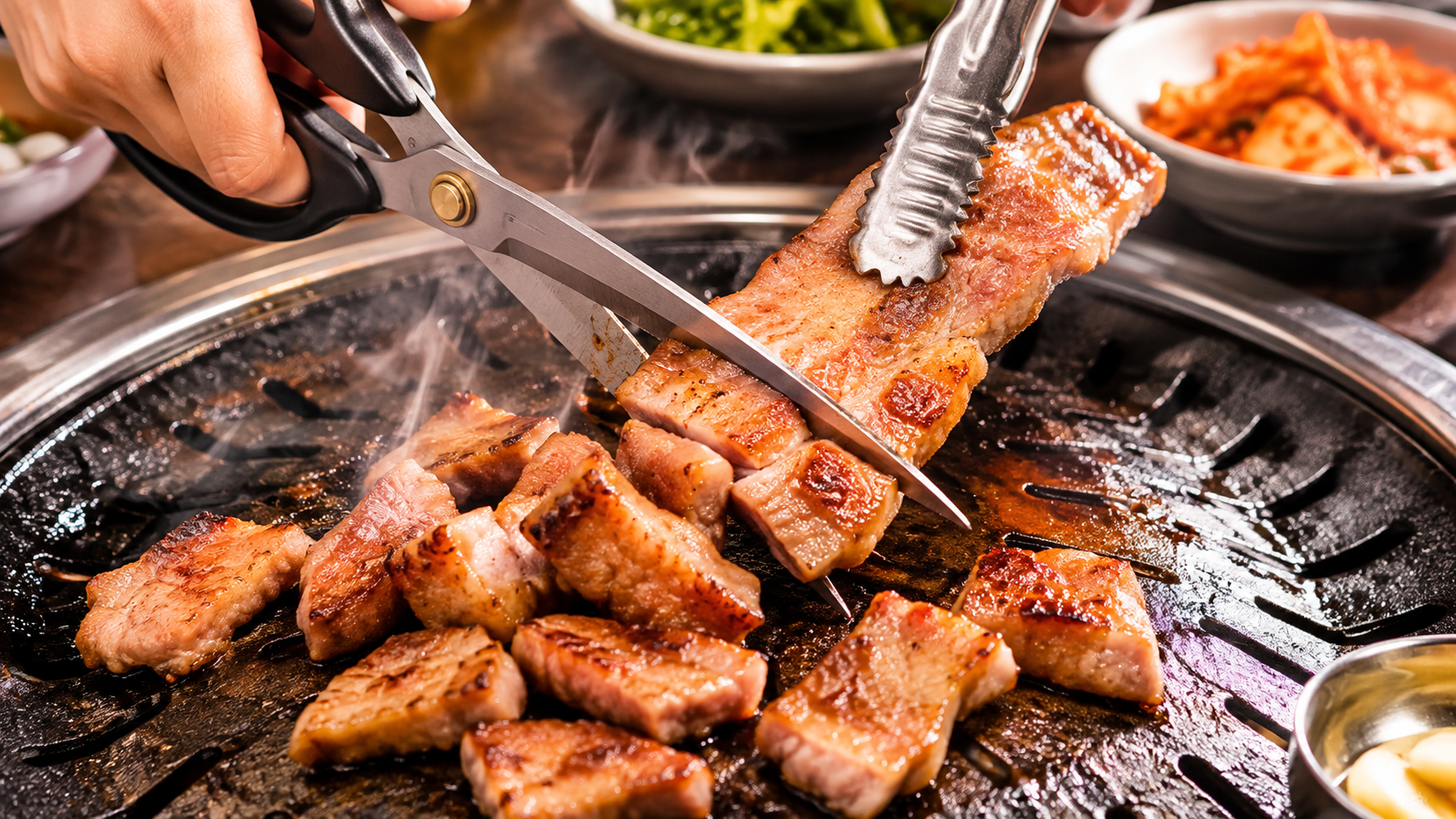
The grill is sizzling right in the middle of the table. A thick piece of samgyeopsal, or Korean pork belly, is slowly turning golden, and the smell of grilled meat is filling the air.
You might expect the server to bring a knife.
Instead, they bring scissors.
At first, you might think, Wait… are those really scissors?
Yes.
And they are about to be used on your dinner.
The server holds the meat with tongs, picks up the scissors, and starts cutting the pork directly over the grill.
Snip.
Snip.
Snip.
In just a few seconds, the large piece of meat becomes several bite-sized pieces.
For Koreans, this scene is completely ordinary.
For many foreign visitors, however, it can be one of those small moments that makes them stop and think:
Why do Koreans use scissors to cut food?
And perhaps even more surprisingly, why are there scissors specifically made for cutting meat, noodles, kimchi, and other foods?
Korean Food Scissors Are More Than Just Scissors
If you are unfamiliar with Korean cooking, it might seem like someone simply grabbed a pair of household scissors from a drawer.
But that’s not really what is happening.
Korean kitchens commonly use food scissors, often called kitchen scissors or cooking scissors, which are designed specifically for food preparation.
They are commonly made with stainless-steel blades and are sold in different shapes and sizes depending on how they are meant to be used.
Some are designed for meat.
Others are marketed for barbecue, noodles, vegetables, seafood, or general kitchen preparation.
Korean kitchenware manufacturers also sell scissors specifically for these purposes.
For example, Korean kitchenware company S produces kitchen scissors and related cooking tools, including products designed for cutting meat, ribs, noodles, and other foods.
Another Korean kitchenware company, D, includes kitchen scissors among its cooking utensils.
In other words, food scissors aren’t simply an unusual trick used by a few Korean cooks.
They have become an established part of Korean kitchenware culture.
So Why Use Scissors Instead of a Knife?
The answer is surprisingly simple:
Because they are convenient.
Think about Korean barbecue.
The meat is often served in larger pieces and cooked directly on a grill placed in the middle of the table.
Instead of taking the cooked meat off the grill, transferring it to a cutting board, and slicing it with a knife, diners can simply hold it with tongs and cut it directly over the grill.
There is less transferring.
Less preparation.
And fewer dishes to clean.
Most importantly, the meat can be cut into bite-sized pieces while it is still part of the shared meal.
This fits naturally with the way Korean barbecue is traditionally enjoyed.
The food isn’t simply placed in front of one person.
It becomes part of the table.
Everyone can grill, cut, wrap, share, and eat together.
The scissors are simply a very practical tool for that style of dining.
But Korean Food Scissors Aren’t Just for Meat
Here’s where things get even more interesting.
If you have ever ordered naengmyeon, Korean cold noodles, you may have seen the same pair of scissors sitting beside the bowl.
Naengmyeon noodles can be long, chewy, and slippery.
For someone using chopsticks, very long noodles aren’t always the easiest thing to eat.
So a pair of scissors makes the problem disappear.
Snip the noodles into shorter pieces, mix them with the broth and toppings, and you’re ready to eat.
It’s quick and easy.
Interestingly, cutting noodles is not necessarily part of every traditional Korean noodle tradition.
Discussions surrounding traditional Pyongyang-style naengmyeon, for example, have noted differences in how noodles were traditionally eaten and whether they should be cut.
This is an important detail because it reminds us that today’s Korean dining habits are not always ancient customs.
Some developed or became widespread as Korean restaurants and modern dining culture changed.
Even Kimchi Can Meet the Scissors
Then there’s kimchi.
If you’ve ever watched someone prepare a large piece of napa cabbage kimchi, you may have seen them pick up kitchen scissors instead of a knife.
Rather than placing the kimchi on a cutting board, they simply cut the leaves directly into smaller pieces.
It’s fast.
It’s clean.
And there’s no need to bring out another cutting board.
Again, most Koreans don’t think of this as anything particularly special.
It’s just an easy way to prepare food.
And that is exactly what makes it interesting from a cultural perspective.
Some of the most fascinating differences between countries aren’t grand traditions.
They are tiny habits people don’t even realize they have.
When Did Koreans Start Using Scissors at the Table?
This is where the story gets a little more complicated.
Scissors themselves are certainly not new to Korea.
But the modern practice of using kitchen scissors directly at the dining table appears to have become widespread much more recently.
Korean cultural reporting has discussed the spread of table scissors from restaurants serving foods such as naengmyeon, particularly around the 1970s, before their use became increasingly common in Korean barbecue and other restaurants.
It is therefore safer to say that the modern restaurant culture of using scissors at the table developed relatively recently, rather than claiming that Koreans have been doing it unchanged for hundreds or thousands of years.
That distinction matters.
A habit can feel ancient simply because an entire generation grew up with it.
But everyday culture is constantly changing.
Sometimes something begins as a practical solution, becomes popular, and eventually becomes so normal that nobody remembers life without it.
Food scissors are a good example.
Why Are Food Scissors So Useful in Korean Cooking?
Once you look at Korean food more closely, the popularity of scissors starts to make sense.
They are convenient for grilled meat
Large pieces of meat can be cut directly over the grill.
They work well with long foods
Noodles, green onions, seaweed, and other ingredients can be quickly divided into smaller pieces.
They are useful for shared meals
Korean meals often include dishes shared by everyone at the table. Scissors make it easy to divide food into manageable portions.
They reduce extra preparation
You don’t always need to transfer food to a cutting board just to make it smaller.
They fit the Korean dining experience
Food preparation and eating often happen together at the table.
The scissors simply make that process easier.
A Different Way of Thinking About the Dinner Table
Perhaps this is the most interesting part of the story.
The difference isn’t really about scissors versus knives.
It’s about how the meal itself is experienced.
In many Western dining settings, food is largely prepared in the kitchen before it reaches the table.
A steak arrives ready to be eaten.
Vegetables have already been cut.
Noodles are already portioned.
The diner mainly uses a knife and fork to eat.
Korean meals can be more interactive.
At a Korean barbecue restaurant, the table can also become the cooking area.
Meat cooks in front of you.
Someone turns the meat.
Someone cuts it.
You wrap it in lettuce.
You add garlic, sauce, or other ingredients.
Then you share it with the people sitting around you.
The table isn’t simply where you eat.
It is part of the cooking experience.
And that helps explain why a pair of scissors feels so natural there.
From Restaurants to Korean Home Kitchens
The same habit has moved beyond restaurants and into everyday Korean homes.
Food scissors can be used to cut meat before cooking, trim green onions, cut seaweed, divide noodles, prepare kimchi, or handle other ingredients.
Because they can perform so many small jobs, they often become one of those kitchen tools that people reach for without even thinking.
It’s similar to how someone might instinctively reach for a spoon or spatula.
Except in Korea, sometimes the answer is simply:
Grab the scissors.
Why Does This Surprise Foreigners?
If you’re visiting Korea for the first time, this is exactly the kind of small cultural difference you might notice.
You may already know about Korean barbecue.
You may know about kimchi.
You may even know that Korean meals often come with many side dishes.
But you might not expect someone to hand you a pair of scissors and say, essentially:
“Here. Cut your dinner.”
And yet, after watching it happen a few times, the idea starts to make perfect sense.
The scissors aren’t being used because Koreans don’t know how to use knives.
They’re being used because for certain Korean foods, scissors are simply more practical.
A Small Pair of Scissors, A Bigger Piece of Korean Culture
This is what makes everyday Korean culture so fascinating.
You don’t always have to look at palaces, traditional clothing, or major festivals to discover something interesting about Korea.
Sometimes you just have to sit down at a restaurant and look at what is happening on the table.
A piece of pork.
A pair of tongs.
A pair of scissors.
A bowl of noodles.
A plate of kimchi.
None of these things seems particularly remarkable on its own.
But together, they tell a small story about Korean food culture: sharing, convenience, interaction, and preparing food together.
So the next time you sit down at a Korean barbecue restaurant and someone reaches for a pair of scissors, don’t be surprised.
They’re not handing you an office supply.
They’re handing you a tool that has become a familiar part of Korean cooking and dining.
And after a few snips, you may find yourself thinking something else:
Why don’t we use scissors for this more often?