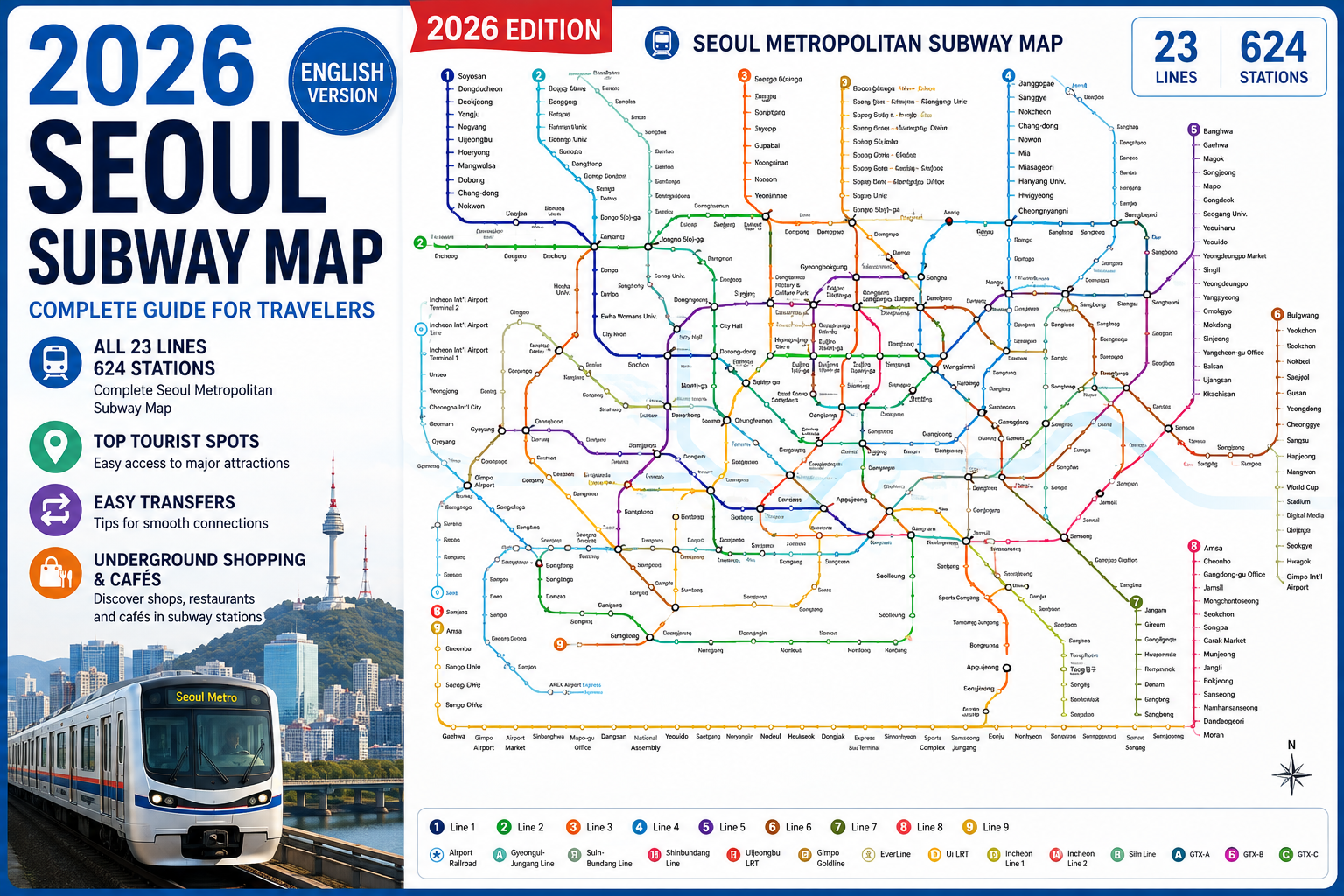
The first time you look at a Seoul Subway Map, it can seem overwhelming.
There are numbered lines, different colors, transfer stations, and hundreds of stops spread across Seoul and the surrounding metropolitan area.
But there is good news: you do not need to memorize the entire map to use the Seoul Subway.
What makes the system especially interesting for visitors is that a subway station in Seoul can be more than a place to catch a train. Depending on the station, you may find shopping areas, cafés, restaurants, convenience stores, and other businesses along the way.
In some cases, people visit a subway station not simply because they need transportation, but because of what they can find inside or around it.
That is one of the things I find interesting about getting around Seoul.
Line 2: The Line I Find Especially Interesting
For me, Seoul Subway Line 2 is one of the most interesting lines to explore because it connects several well-known areas, including Gangnam, Hongdae, Sinchon, Jamsil, and City Hall.
One of the best examples is Gangnam Station.
Gangnam Station is directly connected to an underground shopping area with more than 200 shops. The official Visit Gangnam guide lists mobile phone specialty stores, beauty shops, young casual fashion stores, clothing, cosmetics, electronics, and interior accessories among the types of businesses found there.
What I find interesting is how easily transportation and everyday shopping can blend together.
You might enter Gangnam Station because you need to take Line 2. Before reaching the platform, however, you may find yourself looking at clothes, cosmetics, accessories, or stopping for coffee or food.
The exact businesses vary from station to station, but this combination of transportation and commercial space is something visitors can notice while exploring Seoul.
And Line 2 gives you access to much more than Gangnam.
At Hongik University Station, you can reach Hongdae, an area known for shopping, entertainment, restaurants, and youth culture.
At Jamsil Station, you can experience another very different part of Seoul.
Jamsil Station: Shopping, Dining and Entertainment
Jamsil Station is served by Subway Lines 2 and 8.
The area around the station provides access to major shopping and entertainment destinations, including Lotte Department Store, Lotte World Mall, and Lotte World.
For a visitor, this can be particularly convenient.
You can get off the subway and continue to shopping, restaurants, cafés, and entertainment without having to make a completely separate trip across the city.
Jamsil is a good example of why I do not think of Seoul’s subway simply as a way to move from one tourist attraction to another.
Sometimes, what you find around the station becomes part of the experience.
Seoul Subway Lines: A Simple Guide
You do not need to memorize every station. For a first trip, it is more useful to remember a few major areas connected by each line.
Line 1 — Central Seoul and Historic Areas
Opened in 1974, Line 1 passes through important central areas and can be useful for Seoul Station, Jongno, and traditional markets such as Gwangjang Market.
Line 2 — Gangnam, Hongdae, Jamsil and City Hall
A major circular line connecting several of Seoul’s best-known areas for shopping, entertainment, business, and modern city life.
Line 3 — Palaces and Traditional Seoul
Useful for reaching Gyeongbokgung Palace and cultural areas such as Samcheong-dong.
Line 4 — Myeongdong, Dongdaemun and Central Seoul
Useful for shopping, fashion, historical sites, and central Seoul.
Line 5 — Gwanghwamun and Yeouido
Connects important areas including Gwanghwamun and Yeouido.
Line 6 — Itaewon and Other Neighborhoods
Serves Itaewon, Hangangjin, Hapjeong, and other areas known for restaurants, shops, and nightlife.
Line 7 — Southern and Eastern Seoul
Connects several parts of Seoul and continues into the surrounding metropolitan area.
Line 8 — Southeastern Seoul and Seongnam
Useful for travel between southeastern Seoul and parts of Seongnam.
Line 9 — Gimpo Airport, Yeouido and Southern Seoul
Connects Gimpo Airport with important areas including Yeouido and southern Seoul.
You do not have to remember all nine lines before your trip.
Start with the line you need, find your destination, and check whether you need to transfer.
Don’t Forget the Underground Shopping
One of the most interesting things about the Seoul Subway is what you can find after entering a station.
A subway ride can turn into an unexpected shopping stop.
You may see a clothing store.
Then a cosmetics shop.
A phone store.
A café.
A food shop.
And suddenly, you realize that you have been walking through an underground commercial area before even reaching your train.
The size and selection vary from station to station, so not every subway station offers the same experience.
One particularly well-known example is Goto Mall at Express Bus Terminal Station.
The official Seoul tourism guide describes Goto Mall as the largest underground shopping center in Gangnam. Visitors can find clothing, cosmetics, accessories, interior goods, handmade items, flowers, and more. The mall is located at Express Bus Terminal Station, which is served by Subway Lines 3, 7, and 9.
The surrounding area adds even more options. Central City is connected to the Seoul Express Bus Terminal and Goto Mall, with additional commercial and dining facilities nearby.
There is even an underground pedestrian connection from Express Bus Terminal Station toward Banpo Hangang Park, with a tourist information center offering services in English, Chinese, and Japanese.
If shopping is part of your Seoul trip, searching only for “Seoul shopping” may cause you to miss some of these underground areas.
Try searches such as “Seoul subway underground shopping,” “Gangnam Station underground shopping,” or “Goto Mall Seoul.”
You may find that some of the most convenient shopping opportunities are literally on your route.
One Tip for First-Time Visitors: Avoid the Morning Rush
If you are using the Seoul Subway for the first time, there is one period I would recommend avoiding if your schedule allows:
the weekday morning rush hour.
During this time, major subway stations can become extremely crowded as large numbers of commuters travel to work.
When a train arrives and the doors open, passengers getting off move out quickly, followed almost immediately by people waiting on the platform to board.
As the train becomes close to full, passengers may have to stand with very little space between one another.
Sometimes, even finding a comfortable place to stand or a pole to hold can be difficult. Once the doors close, passengers may remain packed closely together until the next station.
For a first-time visitor, this can be especially challenging if you are also trying to read the subway map, find your transfer station, or locate the correct exit.
It can be even more difficult if you are carrying luggage.
So, if your schedule is flexible, consider traveling outside the busiest weekday morning commute period when sightseeing or shopping.
On the other hand, if you are curious about what Seoul’s everyday commute actually looks like, experiencing it once can certainly be memorable.
Just don’t be surprised if the train is much more crowded than you expected.
And if you do travel during a busy period, keep your luggage close and avoid standing directly in front of the train doors.
A Simpler Way to Read the Seoul Subway Map
The Seoul Subway Map may look complicated at first, but you only need a few pieces of information for each trip:
Your line.
Your destination.
Your transfer station, if needed.
And your exit number.
Once you know those four things, the map becomes much easier to understand.
And don’t be surprised if your trip involves more than simply getting on a train.
You might stop for coffee.
You might grab something to eat.
You might browse a clothing store.
You might discover an underground shopping area.
Or you might get off at a station that puts you right next to a major department store or amusement park.
That is one of the things I find most interesting about using the subway in Seoul.
The subway is not just how you get somewhere. Sometimes, what you discover along the way becomes part of the trip.