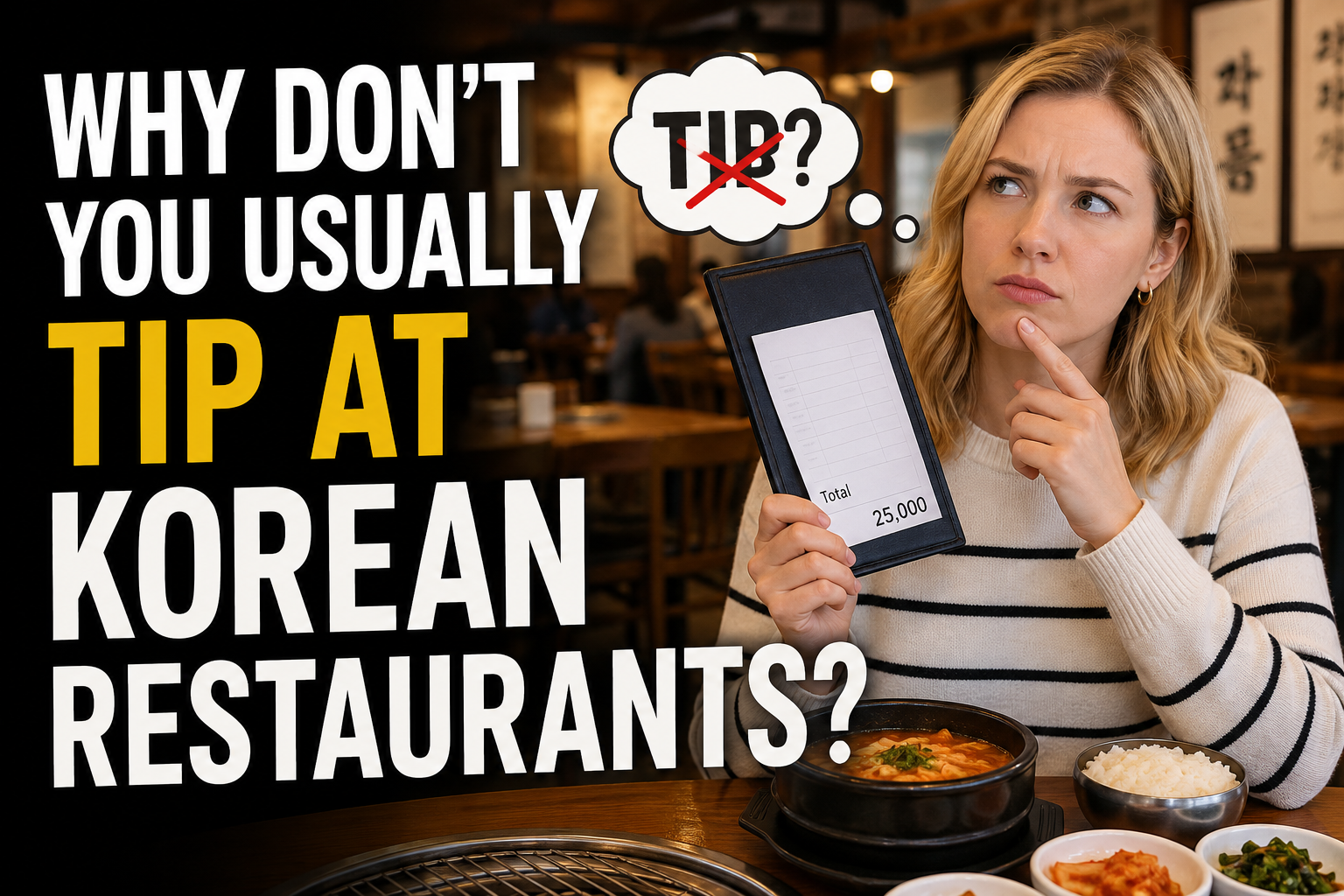
Imagine you’ve just finished your first meal at a Korean restaurant.
The food was delicious. Your server was friendly. They refilled your water, explained the menu, and made sure everything was going well.
Then the bill arrives.
You look at the total and instinctively start doing the math.
15%? 18%? 20%?
But then you stop.
There is no tip line.
No suggested percentage.
No payment screen asking you to choose between 15%, 20%, or 25%.
Just the price of your meal.
You might think:
“Wait… am I supposed to leave a tip?”
Usually, the answer is no.
At most ordinary Korean restaurants, tipping is not a standard expectation.
For Koreans, this is completely normal.
But for someone from the United States, where tipping is deeply connected to restaurant culture, the experience can feel surprisingly different.
And once you understand why, you’ll begin to see that the difference isn’t simply about money.
It’s about expectations, appreciation, and how people express satisfaction with good service.
The Price on the Menu Is Usually the Price You Pay
In Korea, tipping is generally not expected at ordinary restaurants.
The Korea Tourism Organization’s official travel information explains that tipping is not customary in Korea and is generally not required at restaurants.
So if your meal costs 30,000 won, you would normally expect to pay the listed amount rather than automatically adding another 15%, 18%, or 20%.
That may sound like a small difference.
But if you’re used to American restaurant culture, it can completely change the way you experience the end of a meal.
In the United States, you may look at the food price, consider taxes, think about the service, and then calculate a tip before you know your final total.
In Korea, the process is usually much simpler.
You eat.
You get the bill.
You pay.
And you leave.
There is generally no additional percentage that you are expected to calculate for your server.
But What If the Service Was Really Good?
This is where a visitor from the United States might feel a little confused.
Imagine your Korean server was incredibly helpful.
They explained the menu because you couldn’t read Korean.
They showed you how to cook the meat.
They brought extra water.
Maybe they even helped you figure out how to eat a dish you’d never tried before.
In the United States, you might immediately think:
“They deserve a good tip.”
In Korea, you can absolutely appreciate that service.
But appreciation doesn’t automatically have to become a percentage added to the bill.
You might simply say:
“Thank you.”
You might come back to the restaurant.
You might recommend it to your friends.
Or you might leave a positive review online.
The important difference is that good service does not automatically create a tipping obligation.
Is Tipping Considered Rude in Korea?
Not necessarily.
This is something visitors should understand before traveling to Korea.
If you eat at a typical Korean restaurant and don’t leave a tip, you are generally not being rude.
You’re simply following the local custom.
At the same time, tipping isn’t necessarily forbidden.
Some restaurants and businesses have experimented with optional tipping systems, such as tip jars or digital tipping options.
These attempts have attracted attention precisely because tipping is still not deeply established in everyday Korean restaurant culture.
So if you see an optional tip screen or tip jar, you can decide for yourself.
But you don’t need to walk into a Korean restaurant assuming that you are expected to leave 20%.
Optional tipping and expected tipping are two very different things.
Why Didn’t Tipping Become Normal in Korea?
There isn’t one single reason.
Korean restaurant culture developed differently from restaurant culture in the United States.
One important difference is how customers traditionally view the relationship between the price of a meal and the service they receive.
In Korea, restaurant service has generally been understood as part of the overall dining experience rather than something that requires customers to calculate an additional percentage afterward.
The restaurant provides the food and service.
The restaurant employs the staff.
The customer pays for the meal.
The customer isn’t normally expected to decide how much additional money the server should receive after every meal.
That doesn’t mean Korean customers don’t care about service.
They certainly do.
People notice when service is excellent.
They also notice when service is poor.
The difference is that service quality and tipping are not traditionally connected in the same way they are in the United States.
So How Do Koreans Show Appreciation?
This is perhaps one of the most interesting parts of Korean restaurant culture.
If Koreans don’t usually show appreciation through tipping, does that mean they don’t express gratitude?
Not at all.
They simply have different ways of showing it.
If a server is especially kind or helpful, a customer might simply say:
“Thank you so much.”
That may sound simple, but expressing appreciation directly is completely natural.
And if someone discovers a restaurant they really love, they may recommend it to family, friends, coworkers, or people they know.
You might hear someone say:
“The food here is really good.”
“The staff are so friendly.”
“You should come here with me next time.”
In other words, a satisfied customer can become a kind of unofficial promoter for the restaurant.
Online reviews are another important way people express satisfaction.
If someone has a particularly good experience, they may leave a positive review or give the restaurant a high rating.
Today, when people often check online reviews before choosing where to eat, a positive review can be a meaningful way of supporting a restaurant.
So in Korea, appreciation doesn’t necessarily mean asking:
“How much extra money should I leave?”
It can also mean:
“How can I tell other people about this great place?”
That might be through a kind word to the staff, a recommendation to friends, a return visit, or a positive online review.
Then Why Is Tipping Becoming a Topic in Korea?
This is where the story gets more interesting.
Although tipping isn’t traditionally expected in Korea, some modern businesses have started experimenting with tipping.
Some restaurants have placed tip jars near the register.
Others have introduced optional tipping through digital payment systems.
These changes have generated considerable discussion in Korea.
Why?
Because many Koreans don’t necessarily see tipping as a natural part of restaurant culture.
Instead, some people worry that a system that begins as optional could eventually become something customers feel pressured to participate in.
Today, the question might be:
“Would you like to leave a tip?”
But people may wonder whether tomorrow’s question will become:
“How much are you supposed to tip?”
And eventually:
“Will people think I’m rude if I don’t?”
That is one reason tipping remains a sensitive topic in Korea.
A Korean Restaurant Bill Can Feel Surprisingly Simple
For an American visitor, one of the most noticeable moments may come when the bill arrives.
You don’t necessarily have to prepare yourself for another calculation.
If your meal costs 40,000 won, you generally expect to pay around that amount rather than automatically adding another percentage for the server.
Of course, specific pricing practices can vary by restaurant, so it’s always sensible to check the actual bill.
But at a typical Korean restaurant, there is generally no expectation that you will automatically add a restaurant tip.
That can make the final part of a meal feel surprisingly straightforward.
You don’t have to wonder whether 18% is generous enough.
You don’t have to worry that leaving 15% will make you look cheap.
And you don’t have to feel guilty because you didn’t calculate the tip correctly.
What If You Really Want to Tip?
Let’s say you had an amazing experience.
The food was fantastic, the staff were incredibly helpful, and you genuinely want to show your appreciation.
If the restaurant provides an optional tipping system, you can use it.
If there isn’t one, simply saying “Gamsahamnida,” meaning “thank you,” is perfectly appropriate.
You can also tell the staff that you enjoyed the meal or recommend the restaurant to someone else.
The important thing is that you don’t need to feel pressured to create your own tipping system.
Korean restaurant culture generally doesn’t expect you to do it.
So, How Much Should You Tip at a Korean Restaurant?
If you’re asking because you’re planning a trip to Korea, the easiest answer is:
Usually, nothing.
At a typical Korean restaurant, you generally do not need to add a 15%, 18%, or 20% tip.
Pay the bill.
Enjoy the food.
Say thank you.
And leave.
If a particular restaurant clearly offers an optional gratuity, you can decide whether you want to participate.
But don’t assume that every Korean restaurant follows American tipping customs.
They generally don’t.
The Difference Is About More Than Money
At first, the absence of tipping might seem like a simple financial difference.
But it’s really about expectations.
When you grow up in a tipping culture, you learn certain habits without even realizing it.
After eating at a restaurant, you automatically think about the tip.
You consider the quality of service.
You calculate the percentage.
You wonder whether you’ve left enough.
In Korea, many people grow up with a completely different expectation.
They eat at a restaurant.
They receive service.
They pay the bill.
And they leave.
But that doesn’t mean they don’t value good food or excellent service.
They may simply express that satisfaction differently.
A sincere “thank you” to the staff can be one way.
Recommending the restaurant to friends and family can be another.
Returning to the restaurant can show that the experience was worth repeating.
And leaving a positive online review can help other people discover the restaurant.
So the difference isn’t necessarily about whether people appreciate good service.
It’s about how that appreciation is expressed.
A Small Restaurant Habit With a Bigger Cultural Meaning
At first, not tipping may seem like a tiny cultural difference.
But it reveals something important about the expectations surrounding dining in Korea.
In the United States, a tip can be closely connected to the customer’s evaluation of service.
In Korea, the relationship works differently.
Good service is appreciated.
Good food is appreciated.
But that appreciation doesn’t automatically become a percentage added to the bill.
Instead, it can be expressed through words, recommendations, repeat visits, and positive reviews.
Neither system needs to be described simply as better or worse.
They developed from different cultural and economic environments.
For someone visiting Korea for the first time, however, understanding this difference can make dining out much easier.
You don’t have to sit at the table wondering whether you’ve forgotten something.
You haven’t.
So, Do You Need to Tip at a Korean Restaurant?
If you’re sitting in a Korean restaurant and wondering whether you need to add 20% to your bill, you can relax.
Usually, you don’t.
At a typical Korean restaurant, tipping is not generally expected.
Check your bill.
Pay the amount shown.
Enjoy your meal.
And if you received wonderful service, don’t be afraid to say “Gamsahamnida.”
If you loved the restaurant, tell your friends.
If you had a great experience, leave a positive review.
Sometimes, that is how appreciation is expressed.
Because in Korea, a good restaurant experience doesn’t necessarily end with a percentage added to the bill.
It might end with something much simpler:
“Thank you. I’ll come back again.”
And perhaps that is the most interesting part of Korean tipping culture.
The absence of a tip doesn’t mean the absence of appreciation.
It simply means appreciation can look different from what you’re used to.