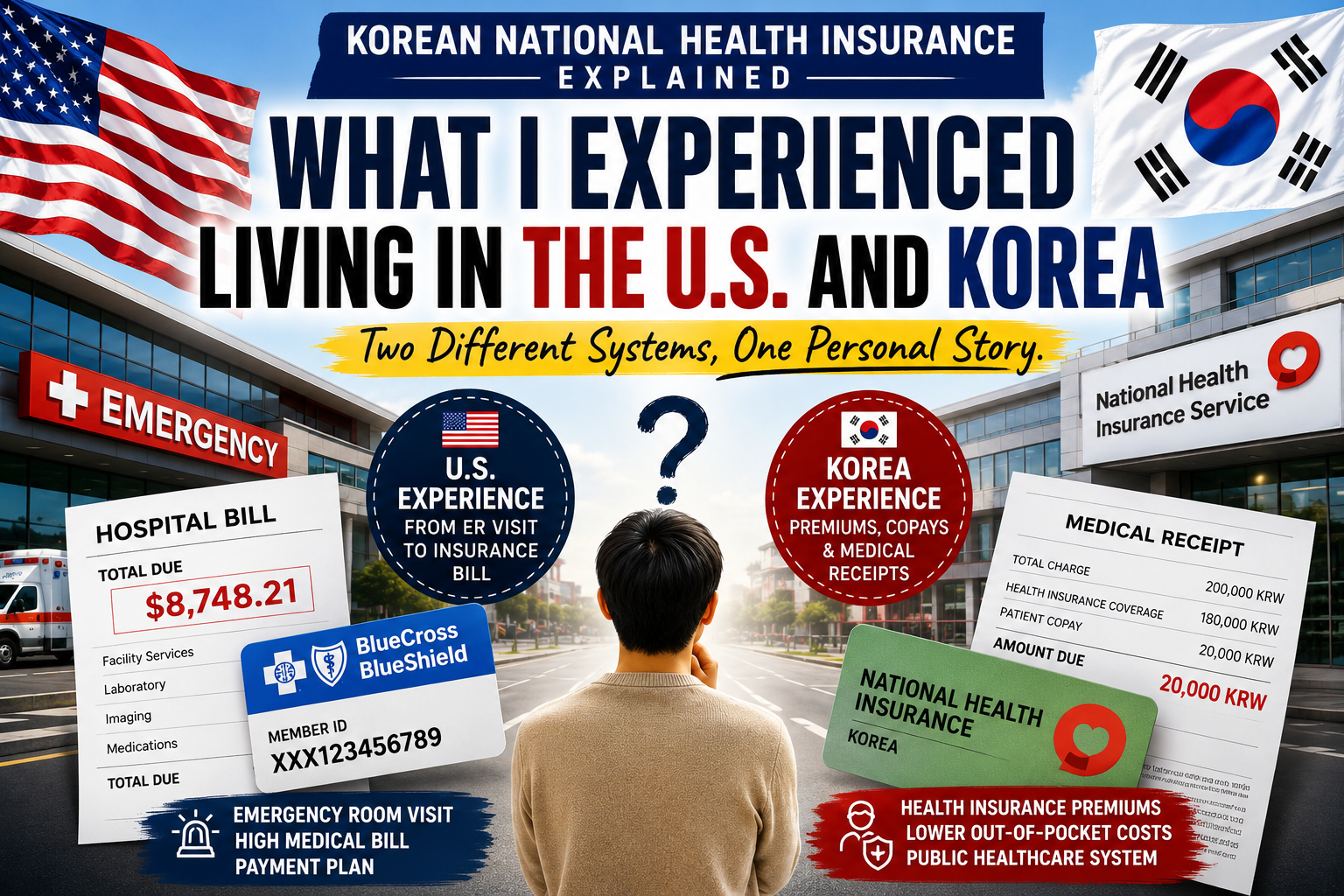
I thought I understood health insurance—until I was the person sitting in front of a hospital bill.
For most people, health insurance is something they pay for every month without thinking about it very much.
The payment goes through, the insurance card stays in the wallet, and everyday life continues.
But that changed for me after experiencing healthcare in both the United States and Korea.
I want to make one thing clear from the beginning.
This is not a comparison of which country’s healthcare system is better or cheaper.
I am not trying to rank the United States and Korea, and my personal experience should not be taken as representative of everyone living in either country.
Healthcare costs and coverage can vary depending on the insurance plan, medical service, income, employment status, residency status, and individual circumstances.
What I am sharing here is much simpler.
This is my personal experience with health insurance and healthcare in the U.S. and Korea—and what I learned from actually using both.
The Day I Ended Up in a U.S. Emergency Room
There is one experience in the United States that made health insurance feel very real to me.
I unexpectedly had to go to an emergency room.
I was taken to the hospital, had several medical tests, stayed overnight, and was eventually discharged.
At that moment, I wasn’t thinking about insurance.
I wasn’t thinking about deductibles, copays, or hospital charges.
I was simply focused on getting through the situation and going home.
The bills came later.
And that was when the experience took another turn.
The total amount was significant.
I had health insurance, but there was still an amount that I was responsible for paying under my particular insurance plan and circumstances.
I applied for financial assistance through the hospital because I hoped there might be a way to reduce the amount I owed.
My application was denied.
So the bill remained.
I am currently paying it off through a payment plan.
That experience is personal to me. It does not mean that everyone with health insurance in the United States will have the same experience, or that every emergency room visit results in a similar bill.
Insurance plans are different. Medical situations are different. Hospital charges and individual financial circumstances are different.
For me, however, this experience changed the way I looked at health insurance.
Until then, health insurance had mostly been a monthly expense.
Afterward, it became something much more tangible.
I had actually used the healthcare system, received medical care, received the bill, applied for assistance, and was now making payments.
That is a very different feeling from simply seeing an insurance premium deducted from your bank account each month.
My Health Insurance Experience in the United States
Today, I live in the United States with my family of three.
We have Blue Cross Blue Shield health insurance, and our monthly premium is in the $600 range.
Under my particular plan, my copay when I see a doctor is $150.
These numbers describe my specific insurance plan and my personal circumstances.
They should not be interpreted as the typical cost for every American family.
In the United States, health insurance costs and out-of-pocket expenses can vary depending on the plan, insurer, employer contribution, deductible, copay, coinsurance, location, income, and other factors.
There is also an important distinction I learned about Marketplace health insurance.
According to HealthCare.gov’s official guidance, Marketplace savings are based on a household’s expected income for the year of coverage, rather than simply the previous year’s income. If income changes during the year, the information can be updated.
That was one of the details I came to understand while navigating the system.
But the bigger lesson came from actually using healthcare.
You can understand words like “premium,” “copay,” “deductible,” and “coverage” by reading about them.
It is different when you are sitting at home with an actual hospital bill in front of you.
Then I Remembered My Experience in Korea
My experience in Korea was different.
Not necessarily better.
Not necessarily worse.
Simply different.
When I used healthcare in Korea, I became familiar with something that many Koreans probably don’t think twice about: the medical receipt.
After receiving medical treatment, I could see the medical charges and the amount I was responsible for paying.
On some occasions, I remember paying around 10,000 won (about $7) for a doctor’s visit.
That may sound surprising to someone unfamiliar with the Korean healthcare system.
But I don’t want to turn my experience into a general statement.
I am not saying that a doctor’s visit in Korea costs 10,000 won.
The amount a patient pays can vary depending on the type of medical service, healthcare institution, insurance coverage, and individual circumstances.
What I can say is this:
I personally remember paying around 10,000 won (about $7) for some doctor’s visits in Korea.
That was my experience.
And then there was another experience that was very different.
One Medical Test Cost Me Around 200,000 Won
At one point, I had a medical test in Korea and remember paying approximately 200,000 won (about $143) out of pocket.
That was a completely different amount from what I had paid for some of my doctor’s visits.
Again, this was my particular medical test and my particular out-of-pocket expense.
It should not be interpreted as the standard cost of medical testing in Korea.
Different medical services have different costs, and the amount covered by National Health Insurance can depend on the service and applicable rules.
What stayed with me was not the idea that one country was cheaper than the other.
It was the realization that my own out-of-pocket costs could change depending on the medical care I received.
That was something I understood much more clearly after actually experiencing it.
Why Was I Paying Korean Health Insurance Without an Income?
There was another part of my experience in Korea that made me curious.
At the time, I was enrolled in Korea’s National Health Insurance as a regional subscriber.
I did not have income in Korea.
But I owned a small apartment outside Seoul.
And I was paying approximately 150,000 won (about $107) per month in health insurance premiums.
At first, I found that confusing.
I remember thinking:
“If I don’t have income, why am I paying a monthly health insurance premium?”
That question eventually led me to learn more about how regional subscriber premiums work.
The current National Health Insurance Service explains that contributions for self-employed, or regional, insured households take household factors including income and property into account. The NHIS currently also lists cars among the factors used in its contribution calculation.
That helped me understand my own situation.
I didn’t have income at the time.
But I did have property.
And my property was relevant to the calculation of my health insurance contribution.
The approximately 150,000 won (about $107) that I paid was therefore a reflection of my own circumstances at that time.
It does not mean that every person without income in Korea pays that amount.
It does not mean that every regional subscriber who owns an apartment pays the same amount.
It was simply my experience.
If you want to understand the current rules rather than rely on an old personal story, the National Health Insurance Service’s official contribution information is a useful place to start.
What I Eventually Understood About Korean National Health Insurance
My experience taught me that it is easy to make assumptions about a healthcare system when you have only heard about it from other people.
It is very different when you actually use it.
Korea’s National Health Insurance is a public social insurance system operated under Korean law. The National Health Insurance Service provides official information about how the system works, including contributions and eligibility.
For me, the important part was realizing that my own experience was only one small part of a much larger system.
I am not trying to explain every detail of Korean National Health Insurance through my personal situation.
Instead, I am using my own experience as a starting point to understand why my particular insurance payments and medical expenses looked the way they did.
There is a difference between saying:
“This is how it happened to me.”
and saying:
“This is how it happens to everyone.”
I want to stay firmly in the first category.
What About Foreigners Living in Korea?
This was another part of the Korean healthcare system that caught my attention.
Korea’s National Health Insurance system can apply to foreign residents as well, depending on their circumstances and the applicable rules.
The current National Health Insurance Act includes specific provisions for foreign nationals and overseas Koreans residing in Korea. Foreign residents working at applicable workplaces can be subject to workplace enrollment, while certain foreign residents who are not workplace subscribers can become regional subscribers when the requirements under the law are met.
The National Health Insurance Service also provides separate official guidance for foreigners. Its current guidance states that certain foreign residents who are subject to regional enrollment become subject to mandatory health insurance after meeting the applicable residence requirements, including the general six-month rule for covered foreign residents.
So if you are a foreigner living in Korea, it is important not to assume that another person’s experience automatically applies to you.
Visa status, employment, residence period, and other circumstances can matter.
The best place to check your own situation is the National Health Insurance Service’s official guidance for foreigners and the Korean National Health Insurance Act.
Korea Also Has Private Health Insurance
Another part of my experience involved private insurance.
In Korea, some people have private health insurance in addition to National Health Insurance.
One type commonly known as indemnity medical insurance, or silbi insurance, can reimburse eligible medical expenses according to the terms of an individual policy.
This is separate from National Health Insurance.
National Health Insurance is part of Korea’s public social insurance system, while private insurance is provided through individual insurance contracts.
The important word here is “eligible.”
Having private insurance does not mean that every remaining medical expense will automatically be reimbursed.
Coverage depends on the specific policy, including its terms, deductibles, exclusions, limits, and other conditions.
This became particularly meaningful to me because I have also had surgery in Korea.
That experience gave me another opportunity to see how medical expenses and insurance can become more complicated when the medical situation itself becomes more serious.
When Health Insurance Becomes More Than a Monthly Payment
When you are healthy, the monthly insurance premium can feel like just another regular household expense.
You pay it every month.
You hope you won’t need much medical care.
And you continue with your life.
I was the same way.
But after actually visiting doctors, having medical tests, receiving hospital care, and dealing with medical bills, I started looking at health insurance differently.
I began paying closer attention to what happened after I received medical care.
What was covered?
What amount was my responsibility?
How did the final bill work?
These weren’t questions I thought about very much when insurance was simply a monthly payment.
They became much more understandable after I experienced the process myself.
The same was true when I used Korea’s National Health Insurance.
After receiving medical treatment in Korea, I could see on my medical receipts how the total medical cost was divided between the amount covered through National Health Insurance and the amount I was responsible for paying.
When I had private insurance, I could also check whether any eligible portion of my remaining medical expenses could be reimbursed according to the terms of my policy.
These experiences taught me something simple.
Health insurance becomes much easier to understand when you experience the healthcare system firsthand.
And that is really what this story is about.
Not which country is better.
Not which system is cheaper.
Not which one everyone should choose.
Simply what I experienced.
Two Different Systems, One Personal Story
Two different systems, one personal story.