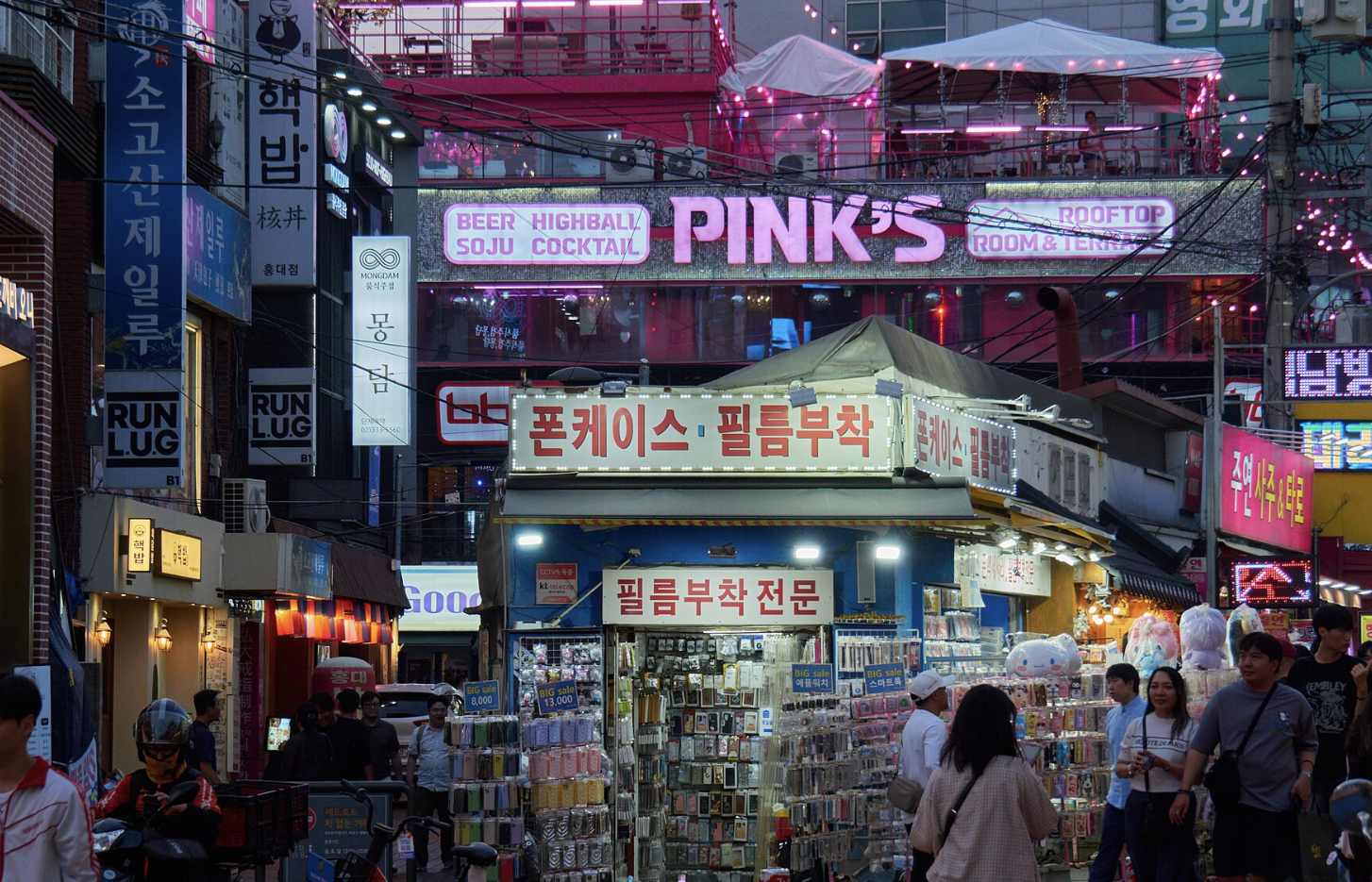
The “Hongdae guy” meme has brought a very specific side of Seoul nightlife into the spotlight. Back when I was a student, Hongdae was packed with young people and students who each seemed to have their own thing going — different styles, different scenes, all crowded into the same streets. Live rock cafés and small stages kept the neighborhood lit up late into the night, one show after another. Maybe because the crowd was always so individual, a lot of what became trendy across Korea seemed to start right there on those same streets. Looking back, that mix had real upsides — but it came with its own downsides too, more than a few of them.
These days I live in the US, so most of what reaches me about the neighborhood comes secondhand — until, lately, one very specific meme.
If you’ve spent any time on TikTok or Instagram Reels this past year, you’ve probably seen him: slicked-back hair, black leather jacket, thick accent, walking up to a foreign woman on the street and asking, “Are you open-mindeu?” That’s the “Hongdae guy” — and the story behind him turned out to be more layered than a single joke.
Where the Character Came From
The meme was popularized by content creator Sean Solo, who began posting parody skits playing an exaggerated version of a familiar Hongdae nightlife type. His character approaches foreign women with a now-recognizable script: “Are you open-minded?” (written in the meme as “open-mindeu,” matching the accent) and “Do you live alone?” One clip, titled “POV: You’re a Black Girl in Hongdae,” has been viewed more than 47 million times and spun off a wave of imitations across TikTok, Instagram, and YouTube.
In interviews, Solo has said the lines weren’t invented from nothing. He’s described hearing similar phrases used by real men trying to pick up foreign women, which is what gave him the idea for the character in the first place.
Why the Joke Landed So Hard
What set this meme apart from a typical internet trend is how many people backed up the stereotype instead of calling it exaggerated. When The Korea Herald visited Hongdae in November 2025 and asked foreign residents directly whether they’d encountered a real “Hongdae guy,” several described run-ins that matched the meme almost line for line.
The Herald’s reporting also noted that this type predates the meme by years — a fairly predictable approach some Korean men have reportedly used on foreign women in Hongdae’s nightlife long before it became content. The meme didn’t invent the pattern; it gave an existing one a name and a costume.
Not everyone treats it as a real problem, though. One bar owner in nearby Yeonnam-dong told the Herald he sees this kind of approach often and doesn’t view it negatively, comparing it to how travelers themselves tend to seek out locals when visiting somewhere new.
When It Stopped Being Funny
The tone shifted for a lot of people in September 2025, after a Taiwanese YouTuber with roughly 460,000 subscribers said she and a friend were assaulted in Hongdae by two men she described as fitting the “Hongdae guy” pattern.
According to her account and Korean news coverage, two men approached the pair, suggested “spending the night together,” and touched her friend without consent. When she objected, an argument broke out, and she says one of the men struck her, leaving bruising and a fractured thumb. She also said the initial police response was dismissive — that officers logged their passport numbers, told them this kind of thing happens often, and released the men without reviewing CCTV footage.
One detail worth including for accuracy: Mapo Police initially misidentified the attackers’ nationality in a preliminary statement, then issued a correction, saying they had confused the case with a separate, unrelated assault nearby the same night. The YouTuber disputed the initial version, saying she was certain the men were Korean based on their language and identification.
This is the specific case The Korea Herald cited when explaining why the meme’s tone had shifted — from something to laugh off on a night out to something with a genuinely uncomfortable edge.
A Neighborhood That Belonged to the Young Long Before Any of This
It’s worth stepping back, because Hongdae was a youth and arts district for decades before any of it went viral. The name comes from Hongik University, whose fine-arts campus has anchored the area since 1955, drawing students, designers, and musicians who needed cheap rent and room to experiment. In 1992, a club called SKA opened as the country’s first rock-café-style venue, and by the mid-1990s Hongdae had become the birthplace of Korea’s indie and underground rock scene — small clubs like Freebird, Master Plan, and Club Drug running punk, rock, and techno nights week after week.
That identity is still very much alive. Live clubs like Rolling Hall, Club FF, and Club Evans book rock, punk, and jazz acts most nights, and the pedestrian street near Hongik University’s Exit 9 turns into a free, informal stage for buskers every weekend evening. It’s part of why the neighborhood pulls in young people, Korean and foreign alike, in the first place — it’s less a single nightlife strip than a decades-old ecosystem of live music, street art, and youth subculture, and the scene the “Hongdae guy” meme is about is only one corner of it.
So — Is Hongdae Actually Dangerous?
Based on everything reported so far, the answer is mostly no, but it’s not entirely nothing either.
The large majority of “Hongdae guy” encounters described in interviews are awkward, unwanted, occasionally funny in hindsight — not dangerous. A cheesy pickup line on a night out is a near-universal experience in any big city’s nightlife district; it isn’t uniquely Korean or inherently threatening. The assault case that made headlines reads, from the reporting available, as an outlier rather than the norm — which is part of why it became national news in the first place.
That said, it’s a documented incident, not internet rumor, and it’s reasonable for visitors — especially those going out solo at night — to factor it in without overcorrecting into unnecessary anxiety about an entire neighborhood.
A Few Practical Habits for a Night Out in Hongdae
None of this is specific to Hongdae, honestly — it’s the same playbook that applies to a night out in most big cities:
- Going out with a group remains the single biggest risk-reducer, and it’s also just more fun.
- Share your location with a friend if your group splits up later in the night.
- If someone won’t take no for an answer, move toward a staffed, well-lit space — a convenience store, a bar with visible staff, a busy main street rather than a side alley.
- Booking a ride through a taxi-hailing app rather than flagging one down late at night logs your route and driver details automatically.
- Save Korea’s emergency numbers before heading out: 112 for police, 119 for medical emergencies. Seoul also runs a 24-hour tourist hotline at 1330 with English-speaking staff.
- If something does happen, ask for a written report and follow up — language and jurisdiction issues were part of what drew criticism in the September 2025 case, and having embassy or Korean-speaking support afterward can make a real difference.
Where I Land on This
The “Hongdae guy” meme is funny because it’s familiar, and it’s familiar because the dynamic underneath it — confident men following a predictable script to approach foreign women in Seoul’s nightlife districts — is something a lot of foreign residents say they’ve genuinely experienced. Most of the time, that’s an awkward five minutes and a good story to tell later, not danger. The September 2025 case is a reminder that annoying and harmless aren’t always the same thing, and it’s worth going into a night out in Hongdae — or anywhere — with a basic plan. But it’s also worth remembering what the neighborhood has always been about: live music, street art, and a kind of restless creative energy that predates any of this by thirty years.
Sources
- “‘Are you ‘open mindeu’?’: When the Hongdae guy meme stops being funny” — The Korea Herald, November 2025
- “Taiwanese YouTuber assaulted in Hongdae after rejecting attackers’ advances” — The Korea Times, September 2025
- “Taiwanese Woman Attacked by Men in Hongdae Says, ‘Police Told Me Not to Cry and Just Go Home'” — The Asia Business Daily, September 2025
- “Exclusive: Sean Solo On Being More Than Just Hongdae Guy” — Buro 24/7 Malaysia, March 2026
- “Exploring Hongdae, where Korea’s indie music, culture thrive” — The Korea Times, October 2025
- “Hongdae’s bohemian raps and dancing” — Korea JoongAng Daily
- Hongdae guy — Wikipedia (timeline cross-reference)