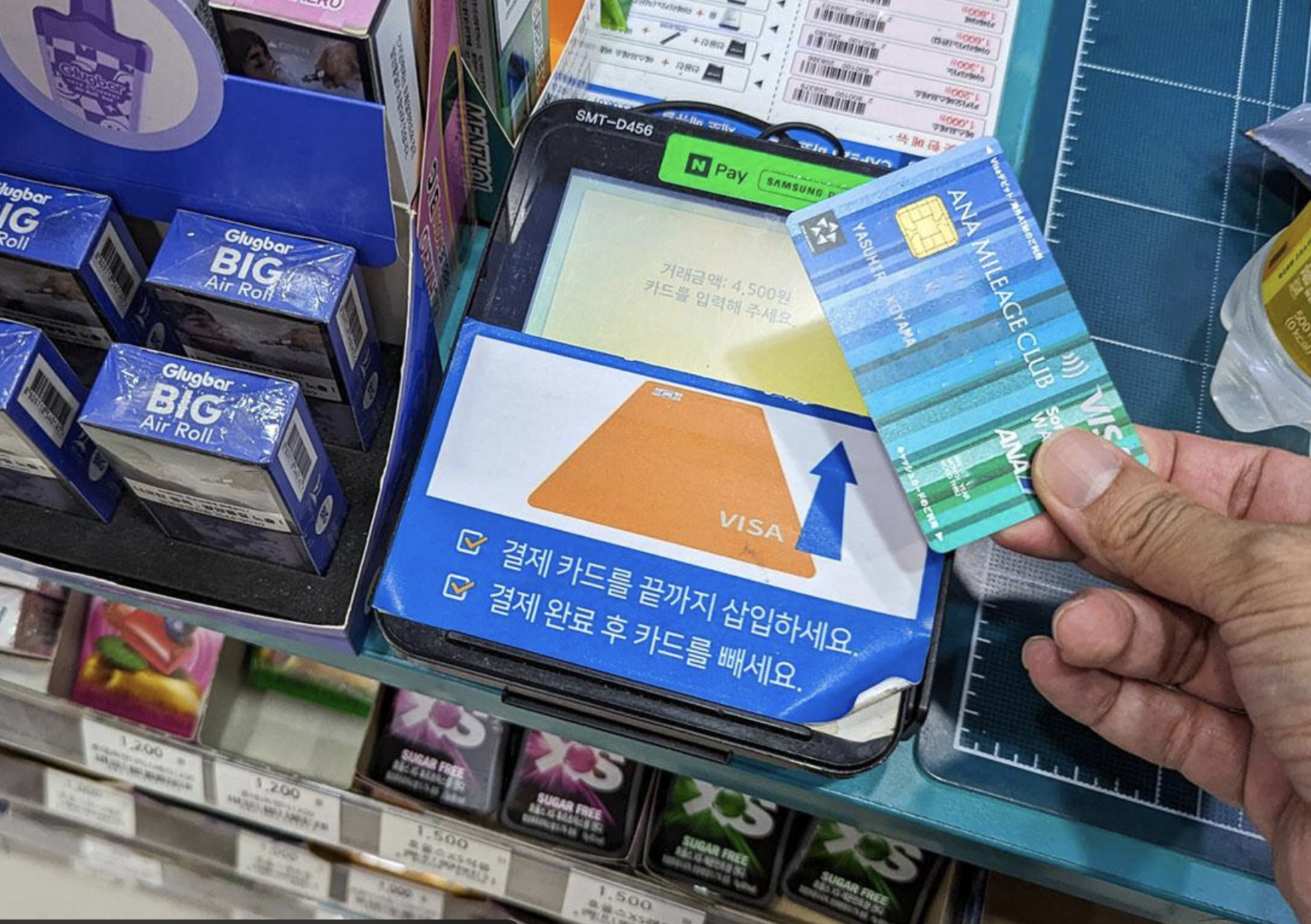
When I went to Korea this summer, I expected using my American credit card to be pretty straightforward. And for the most part, it was.
I used my U.S.-issued Visa card at restaurants, stores, and other places without much trouble. My daughter also used Apple Pay for some of her purchases. It was convenient, especially because we didn’t have to carry a lot of cash around.
But then I noticed something I hadn’t really thought about before: foreign transaction fees.
My daughter noticed the fee on one of her purchases, and it made me wonder: Is this something every American credit card charges? Does Visa charge the fee? Does Apple Pay charge it? Or does it depend on the card itself?
After looking into it, the answer is a little more complicated than I expected.
Can You Use American Credit Cards in Korea?
Yes. Credit cards are widely used in South Korea, and travelers can generally use major U.S.-issued credit cards at many restaurants, cafés, stores, hotels, department stores, and other businesses.
Even in traditional markets, you may find vendors that accept cards. However, I wouldn’t recommend traveling to Korea with no cash at all.
Small street-food stands, some pojangmacha-style vendors, and very small businesses may still prefer cash or may not accept international cards — some don’t even have a card reader, and take a bank transfer instead.
For me, the easiest approach is to use a credit card for most larger purchases while keeping a small amount of Korean won for situations where a card isn’t an option.
Does Every American Credit Card Charge a Foreign Transaction Fee?
No. This is probably the most important thing I learned.
A foreign transaction fee is determined by the card and its terms, not simply by whether the card says Visa or Mastercard. Chase explains that the fee depends on the specific card, and when it applies, it is typically a percentage of the transaction amount — often around 1–3%. Plenty of cards charge nothing.
For cards that do charge a foreign transaction fee, the fee is generally calculated as a percentage of the purchase amount rather than as a flat fee for each purchase.
For example, a 3% foreign transaction fee would mean approximately:
- $50 purchase → $1.50 fee
- $100 purchase → $3 fee
- $500 purchase → $15 fee
The actual amount depends on the exchange rate and the terms of your particular card, so it’s worth checking your own card’s terms before assuming either way.
How Much Do Different U.S. Credit Cards Charge?
This is where things get interesting, because there isn’t one standard fee across all American credit cards — it depends on the issuer, and sometimes on the specific card within that issuer’s lineup.
Here are a few examples based on issuer information available as of August 2026:
| Card issuer / example | Foreign transaction fee | Source |
|---|---|---|
| Capital One — U.S.-issued credit cards | No foreign transaction fee | Capital One |
| Chase — Freedom Unlimited, Freedom Flex*, Freedom Rise, and similar | 3% of each transaction in U.S. dollars | Chase |
| American Express Blue Cash Everyday / Blue Cash Preferred | 2.7% after conversion to U.S. dollars | American Express |
| Wells Fargo Active Cash | 3% of each transaction converted to U.S. dollars | NerdWallet |
| Bank of America — Travel Rewards, Premium Rewards | No foreign transaction fee | Bank of America |
*Chase has announced the Freedom Flex card’s 3% fee is being phased out starting September 2026 — a reminder that these terms change, so it’s worth double-checking your card’s current agreement rather than relying on any list, including this one.
These are examples tied to specific cards, not a blanket rule for every product each bank offers. Capital One currently states that none of its U.S.-issued credit cards include a foreign transaction fee, while Chase, American Express, Wells Fargo, and Bank of America have different terms depending on the specific card.
In other words, don’t assume your card is free to use overseas just because it’s a Visa or Mastercard. Check the name of your exact card and look under its “Fees,” “Rates and Fees,” or “Foreign Transaction” information — or check the card’s terms directly with the issuer, since these rates can change.
What About Apple Pay?
Using Apple Pay doesn’t automatically mean you are paying a separate Apple Pay foreign transaction fee.
What matters is the card connected to Apple Pay.
If you add a U.S. credit card that charges a 3% foreign transaction fee to Apple Pay, using Apple Pay in Korea does not remove that card’s fee. Apple Pay is just the wallet — the fee still belongs to whichever card sits behind it.
So when my daughter used Apple Pay in Korea, the important question wasn’t really “Did Apple Pay charge us?” It was “What card was being used through Apple Pay?”
That’s a useful distinction to remember when traveling.
Should You Pay in Korean Won or U.S. Dollars?
This is another thing I’d pay attention to in Korea.
Sometimes a card terminal or merchant may give you the option to pay in Korean won (KRW) or have the purchase converted into U.S. dollars (USD) on the spot. This is called Dynamic Currency Conversion, or DCC.
Visa’s own explanation of DCC notes that when a merchant offers this option, the price you’re shown includes an exchange rate plus additional fees or markup, and that merchants and ATMs are required to disclose the rate clearly and let you decline it. Visa specifically recommends declining the conversion and paying in the local currency instead, since that markup is on top of — not instead of — whatever your card’s regular foreign transaction fee is.
For that reason, when I’m traveling, I prefer to have the transaction processed in Korean won rather than letting the merchant convert it to U.S. dollars at the point of sale.
What About Pulling Cash Out With a Credit Card?
I didn’t end up needing to do this myself, but it’s worth explaining clearly, because it’s one of the more expensive mistakes you can make with a U.S. credit card in Korea.
Withdrawing cash from a Korean ATM with a credit card is technically possible at machines marked “Global ATM” or displaying your card’s network logo, but it isn’t treated like a normal purchase. Card issuers generally classify it as a cash advance — essentially a short-term loan against your credit line — and that comes with its own separate fee, plus interest that typically starts accruing immediately, with no grace period the way a regular purchase would have.
A few practical points if you’re considering it anyway:
- You’ll likely need to set up a cash advance PIN with your card issuer before you leave the U.S. — many travelers get rejected at the ATM simply because they never set one.
- The Korean ATM operator’s fee is only part of the cost. Your issuer’s cash advance fee and interest charges show up later on your statement, not on the ATM receipt.
- ATMs in Korea will often prompt for currency choice too — the same DCC advice applies: choose won.
The near-universal advice from Korea travel guides is the same: use a debit card, not a credit card, for cash withdrawals. A debit card pulls from your actual bank balance rather than triggering a cash advance, so you avoid the extra fee-and-interest structure entirely. If your only card is a credit card, it’s worth calling your issuer beforehand to understand exactly how they treat foreign ATM withdrawals before you’re standing at a machine trying to figure it out.
Do You Still Need Cash in Korea?
I’d say yes — but probably not as much as you might expect.
Korea is very convenient for card users, and I rarely felt like I needed to carry a large amount of cash.
Still, having some Korean won available can make things easier when you visit:
- Small street-food vendors
- Pojangmacha-style food stands
- Small local shops
- Certain market stalls
- Places where an international card doesn’t work
I personally like having a small amount of cash available and using my card for everything else.
What Should You Check Before Traveling to Korea?
Before your next trip, take five minutes to check your card.
1. Check the foreign transaction fee. Look at the terms for your exact card — not just the name of the bank.
2. Check your international spending limits. Make sure you know your available credit and ATM limits.
3. Bring more than one payment method. I wouldn’t rely on a single card while traveling internationally.
4. Keep some Korean won with you. You may not use it often, but you’ll be glad to have it when you need it.
5. Pay attention to the currency on the terminal. If you’re given the choice between KRW and USD, understand what you’re agreeing to before pressing the button.
My Takeaway
After using American cards in Korea this summer, I came away with a simple conclusion: you can absolutely travel around Korea using a U.S. credit card, but you should know your card’s foreign transaction fee before you go.
Korea is much more card-friendly than some first-time visitors might expect. At the same time, cash still has its place, especially when you’re exploring traditional markets or small street-food businesses — and avoid using a credit card at a Korean ATM unless you understand exactly how your issuer treats it.
And if you use Apple Pay, don’t assume that mobile payment means there are no foreign transaction fees. The fee usually comes down to the card behind the wallet.
For me, the best combination is simple: a credit card with no foreign transaction fee, a small amount of Korean won, and a little attention to whether the terminal is charging you in KRW or converting the purchase to USD.
That small bit of preparation can make paying for things in Korea much easier — and help you avoid an unpleasant surprise when you get home and open your credit card statement.
Fee information above reflects issuer terms as of August 2026 and is provided for general information only, not financial advice. Card terms change, so confirm current rates directly with your card issuer before traveling.
SEO Package
SEO Title: Can You Use American Credit Cards in Korea? What Travelers Need to Know (2026)
Focus Keyword: American credit cards in Korea
Related Keywords: using US credit card in Korea, dynamic currency conversion Korea, foreign transaction fee Korea travel, credit card cash advance Korea ATM, Visa Mastercard Korea travelers
Meta Description: A traveler’s real experience using a US Visa card across Korea this summer — the currency-choice issue at checkout, why fees differ by card, and what travelers should know before using a U.S. credit card in Korea.
Permalink: /american-credit-cards-korea-guide
Thumbnail Concept: A close-up of a hand holding a generic U.S. credit card toward a Korean payment terminal, with the terminal’s small screen showing a blurred currency-choice prompt (KRW / USD) — warm indoor lighting suggesting a cafe or restaurant counter, no visible faces or identifiable card numbers.
ALT Text: US credit card being used at a payment terminal in Korea showing currency selection screen
Internal Link Suggestions:
- Link to your existing post covering Korean transportation or travel apps
- Link to a future or existing post on WOWPASS / T-money for tourists, if published
- Link to your Korea cash and payment guide, if published
External Source Suggestions:
- Chase — foreign transaction fee information
- Capital One — foreign transaction fee information
- American Express — Blue Cash card fee information
- NerdWallet — Wells Fargo Active Cash review, including fee terms
- Bank of America — no-foreign-transaction-fee card information
- Visa — Dynamic Currency Conversion information