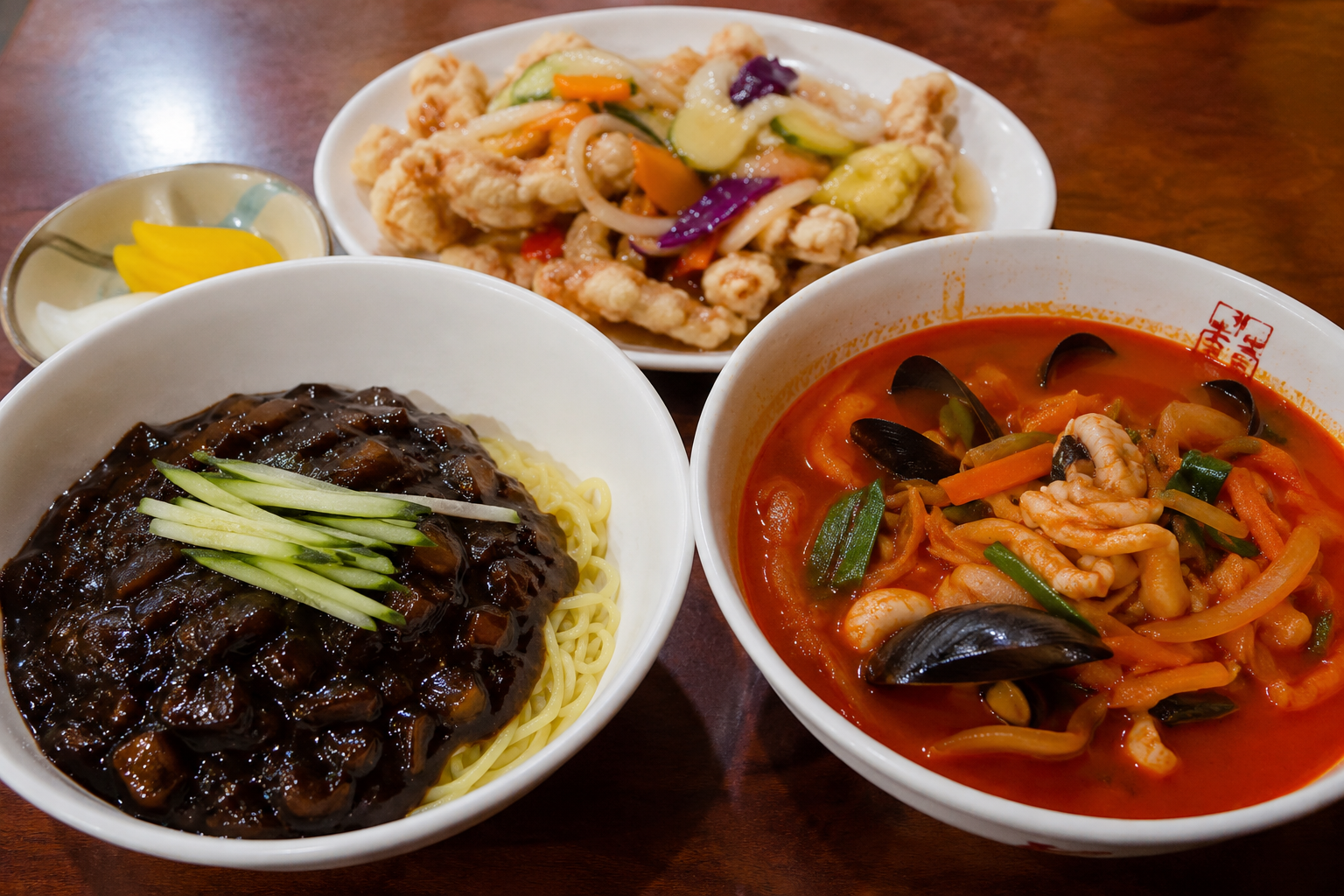
If your introduction to Korean food has mostly been spicy instant noodles, Korean barbecue, or fried chicken, there’s another dish worth knowing about: a bowl of thick noodles under a dark, savory black bean sauce.
For a lot of Koreans, jjajangmyeon isn’t just something you order because it’s good. It’s the food that shows up after a graduation, on the day you move into a new place, and at plenty of ordinary dinners in between. It’s one of the most common dishes on any Korean-Chinese restaurant menu, and it even comes as an instant noodle you can grab off a shelf.
I grew up eating it after school graduations and on moving days. Years later, after my own child’s graduation in California, I ended up at a Korean-Chinese restaurant near the school — and the place was exactly as packed as I remembered from my own childhood. Families everywhere, kids celebrating with their parents, barely room to stand. For a second it genuinely felt like being back in Korea. That’s a lot of why jjajangmyeon has such a specific place in Korean food culture: it’s tangled up with memory almost as much as it is with taste.
What Is Jjajangmyeon?
Jjajangmyeon is a Korean noodle dish built around a thick black bean sauce. The noodles are usually chewy, and the sauce is made mainly from chunjang, a Korean fermented black bean paste, cooked down with pork, onion, and other vegetables. The exact mix depends on where you’re eating.
The first time you see it, the color can throw you off a little — the sauce is almost black. But that dark color is misleading, because jjajangmyeon isn’t spicy at all. The taste leans savory and slightly sweet, with cooked onions bringing natural sweetness and the black bean paste giving it that deep, almost roasted flavor underneath. If you’ve assumed Korean food always means heat, this is a good dish to prove otherwise.
Why It Means So Much to Koreans
Jjajangmyeon gets attached to a handful of very ordinary, very specific moments in Korean life, and that’s a big part of why it means so much.
Moving day is one of them. When you move into a new place, the kitchen is usually still packed in boxes, and nobody has the time or energy to cook. So ordering jjajangmyeon for delivery becomes the obvious answer — and it usually gets eaten sitting among half-unpacked boxes rather than at an actual table.
Graduation is the other. After elementary, middle, or high school ceremonies, Korean families have long gone out to eat together, and a Korean-Chinese restaurant near the school is a natural choice, partly because everyone at the table can order something different. It’s why so many Koreans carry the same memory — a packed restaurant near school on graduation day, full of classmates and their families doing the exact same thing. I have that memory, and, a little unexpectedly, I ran into almost the same scene years later in California. Jjajangmyeon crossed an ocean, but the memory attached to it didn’t change much at all.
The Different Types of Jjajangmyeon
There’s more than one version of this dish, and knowing the differences makes ordering more interesting.
Regular jjajangmyeon is what most people picture: thick noodles topped with a cooked black bean sauce containing pork and onion, mixed together right before eating.
Ganjjajang is made a different way. The sauce is stir-fried at higher heat without any added water, and it’s usually served on the side rather than poured over the noodles. Because it’s cooked fresh to order instead of ladled from a pot, the vegetables keep more bite and the flavor tends to be more concentrated.
Yuni jjajang uses finely minced meat and vegetables instead of diced ones, which gives the sauce a smoother, almost silky texture.
Samseon jjajang adds seafood — usually shrimp or squid — on top of the usual pork and vegetables, and it’s generally treated as the slightly more upscale option.
How It’s Actually Made
The method is a lot simpler than the deep color suggests, which is part of why it’s such an easy dish to make at home, too.
Diced pork, onion, and potato or zucchini get stir-fried first. Separately, the chunjang is fried in oil on its own for a few minutes — this step matters more than it sounds like it would, because raw black bean paste tastes bitter, and frying it mellows it into something closer to caramel. Once that’s done, the fried paste goes in with the meat and vegetables, water gets added, and everything simmers until the vegetables soften. Near the end, a cornstarch slurry thickens it into that glossy, clingy sauce, which then gets ladled over noodles that were just boiled.
Ganjjajang skips the water and cornstarch step entirely, which is exactly why it turns out thicker and usually comes served separately instead of poured on top. It’s also why a version of jjajangmyeon has made its way into home kitchens and instant noodle packets alike — the basic technique isn’t complicated once you know it.
Jjamppong: The Spicy Counterpart
If jjajangmyeon is dark, savory, and mild, jjamppong goes the opposite way entirely. It’s a spicy Korean-Chinese noodle soup built on a flavorful broth loaded with vegetables and usually a generous mix of squid, shrimp, mussels, and cabbage. The broth is typically red and spicy, which makes jjamppong the go-to order for anyone at the table who wants heat instead of sweetness.
There are variations here too — seafood-heavy versions, meat-based versions, and a white jjamppong that trades the red chili broth for something lighter and unspicy, usually built around fresh oysters.
And if you genuinely can’t decide between the two, there’s already a solution for that: a single bowl split evenly between jjajangmyeon on one side and jjamppong on the other, sometimes called jjam-jja-myeon. It’s a very Korean answer to a very simple problem.
Tangsuyuk: The Dish for the Middle of the Table
Order jjajangmyeon or jjamppong with other people, and tangsuyuk almost always ends up in the middle of the table to share. It’s crispy fried pork with a sweet and sour sauce, and the contrast — crunchy against tangy, rich against savory — pairs naturally with a bowl of noodles.
There’s a long-running, mostly good-natured argument about how to eat it, too: pour the sauce directly over the pork, or keep it on the side for dipping. Both camps have their reasons, and the debate comes up at almost every table that orders it.
Is Jjajangmyeon Chinese or Korean?
This is where the history gets interesting. Jjajangmyeon traces back to a noodle dish from northern China, made with noodles and fried bean paste. Chinese immigrants, many of them from Shandong, brought that tradition to Korea in the late 1800s, and Incheon — which opened to foreign trade in 1883 — became a center for Chinese communities and Chinese-style restaurants in Korea.
Over the following decades, the dish kept changing hands and changing shape. The ingredients, the sweetness, the color of the sauce, and the way it was cooked all shifted to match Korean tastes, and what came out the other end was the jjajangmyeon Koreans know today — different enough from the original that it’s usually described as Korean-Chinese food rather than simply Chinese food. The roots are Chinese. The dish that ended up woven into everyday Korean life took its final shape in Korea.
Incheon still holds onto that history closely, and its old Chinatown remains the place most closely tied to how jjajangmyeon came to be.
Jjajangmyeon Also Comes as Instant Noodles
Here’s something people outside Korea might not expect: jjajangmyeon exists as an instant noodle too, and Korea’s instant noodle shelf goes well beyond the spicy stuff. Jjajang-style instant noodles skip the soup entirely — you cook the noodles, drain them, and mix in a thick black bean sauce packet instead — and they’re just as familiar in Korean households as any spicy variety. They’re easy to find in Korean supermarkets in the US as well. It’s a decent example of how a restaurant dish turned into convenience food without losing what made people like it in the first place.
Finding It in the United States
Moving abroad never really meant leaving these dishes behind for Korean immigrants. Korean-Chinese restaurants are a fixture in Korean-American communities in cities like Los Angeles and New York, and they tend to serve the same jjajangmyeon-jjamppong-tangsuyuk combination that anchors menus back in Korea. Some of these places have been run by the same families for decades; others are newer and still building a following. Either way, jjajangmyeon stays one of the more recognizable dishes in Korean neighborhoods across the country.
Korean supermarkets are another easy place to find it. A lot of the larger Korean grocery stores in the US have a food court or a small restaurant counter built into the store, and a Korean-Chinese noodle stand serving jjajangmyeon and jjamppong is a common sight there, right alongside the tteokbokki and bibimbap. It’s become such a standard part of the layout that for plenty of Korean American families, a grocery run and a bowl of jjajangmyeon just go together without much thought involved.
A Food That Carries Memories
What makes jjajangmyeon interesting isn’t that it’s some elaborate dish. It’s the opposite — it’s ordinary. People eat it when they’re busy, tired, celebrating, moving, graduating, or just hungry, and that ordinariness is exactly what makes it stick in people’s memory. For me, it connects a childhood graduation in Korea to a restaurant visit after my own kid’s graduation years later in California, a different country and a different generation but somehow a familiar scene both times. A menu description can’t really capture that part. Sometimes a food ends up meaning something to a whole culture less because of how it tastes and more because of what people remember eating it during.
If you haven’t tried jjajangmyeon, it’s worth going out of your way for. Start with the regular version if you’d rather keep things mild, or go straight for jjamppong if you’re after some heat, and if you’re eating with other people, put tangsuyuk in the middle of the table. It’s an easy dish to end up liking, and it comes with a story a lot of Koreans already carry around with them.