If you’ve ever been to a Korean restaurant, you may have noticed something before your food even arrives.
A small dish of red, spicy vegetables is placed on the table.
Kimchi.
For someone trying Korean food for the first time, kimchi might look like nothing more than a spicy side dish. But ask a Korean person about kimchi, and you may get a very different answer.
Kimchi is something many Koreans grew up eating. It can be found in family refrigerators, served with rice and soup, enjoyed alongside grilled meat, and used as an ingredient in other Korean dishes.
In other words, kimchi isn’t just something Koreans eat.
It’s part of everyday life.
But how did this unusual fermented vegetable become one of the most recognizable Korean foods in the world?
And is kimchi really as healthy as people often say?
Let’s take a closer look.
Where Did Kimchi Come From?
The easiest answer is that kimchi comes from Korea.
The more interesting answer is that kimchi wasn’t invented by one person at one particular moment.
Instead, it developed gradually over a very long period of Korean history.
Long before refrigerators existed, preserving vegetables was an important part of preparing food for the colder months. Salting vegetables was one way to keep them edible for longer periods, and fermentation eventually became an important part of this food tradition.
A 2023 historical review published in the Journal of Ethnic Foods describes kimchi as a traditional Korean fermented vegetable food with a history extending back thousands of years. The researchers explain that kimchi has changed considerably over time as ingredients, preparation methods, and Korean food culture evolved.
So, there isn’t really one “original kimchi recipe.”
What we call kimchi today is the result of generations of people experimenting with vegetables, salt, seasonings, storage, and fermentation.
And that history is part of what makes kimchi so fascinating.
Kimchi Wasn’t Always Red
Here’s something that surprises many people.
The kimchi we know today wasn’t always bright red and spicy.
When most people outside Korea hear the word kimchi, they probably picture napa cabbage covered in red pepper flakes.
That version became popular much later in kimchi’s long history.
The development of today’s red kimchi was influenced by the introduction and use of chili peppers in Korean cuisine. Over time, red pepper became an important seasoning in many varieties of kimchi.
So the bright red color isn’t simply a symbol of kimchi.
It tells part of its history.
And once you start looking at Korean kimchi this way, you realize that the food has continued to change and evolve over generations.
What Makes Kimchi Different From Pickled Vegetables?
This is where things get especially interesting.
Kimchi isn’t simply vegetables sitting in vinegar.
Traditional kimchi is a fermented food.
The vegetables are usually salted first and then mixed with seasonings such as garlic, ginger, green onion, red pepper, and, depending on the recipe, fish sauce or fermented seafood.
After that, microorganisms naturally present in the ingredients become involved in the fermentation process.
Among them, lactic acid bacteria are particularly important.
Research on kimchi fermentation has identified bacteria from groups such as Leuconostoc, Weissella, and Lactobacillus as important participants in the process.
As fermentation continues, these microorganisms transform available carbohydrates and produce organic acids.
And that’s one of the reasons kimchi develops its familiar tangy flavor.
Fresh kimchi can taste crisp, salty, spicy, and slightly sweet.
After more fermentation, it becomes increasingly sour and develops a deeper flavor.
So when your kimchi tastes different after spending some time in the refrigerator, that’s not your imagination.
Your kimchi is changing.
Why Does Kimchi Become More Sour?
This is one of the fun things about having kimchi at home.
You can taste it at different stages.
Freshly made kimchi is often crunchy and strongly seasoned. After some time, the sourness becomes more noticeable.
The fermentation process continues more slowly under refrigeration, and acidity gradually increases.
Temperature and other conditions can affect which microorganisms become dominant and how quickly fermentation progresses.
This is also why Koreans don’t necessarily throw away kimchi just because it has become very sour.
Quite the opposite.
Sour, well-fermented kimchi can be perfect for cooking.
It’s commonly used in dishes such as kimchi jjigae, kimchi fried rice, and other Korean recipes.
Fresh kimchi for the side dish.
Older kimchi for cooking.
It’s almost like getting two different foods from the same jar.
How Many Types of Kimchi Are There?
If you’ve only tried the red napa cabbage version, you have only seen a small part of the kimchi world.
Kimchi is actually a broad family of fermented vegetable dishes.
Here are a few you may come across.
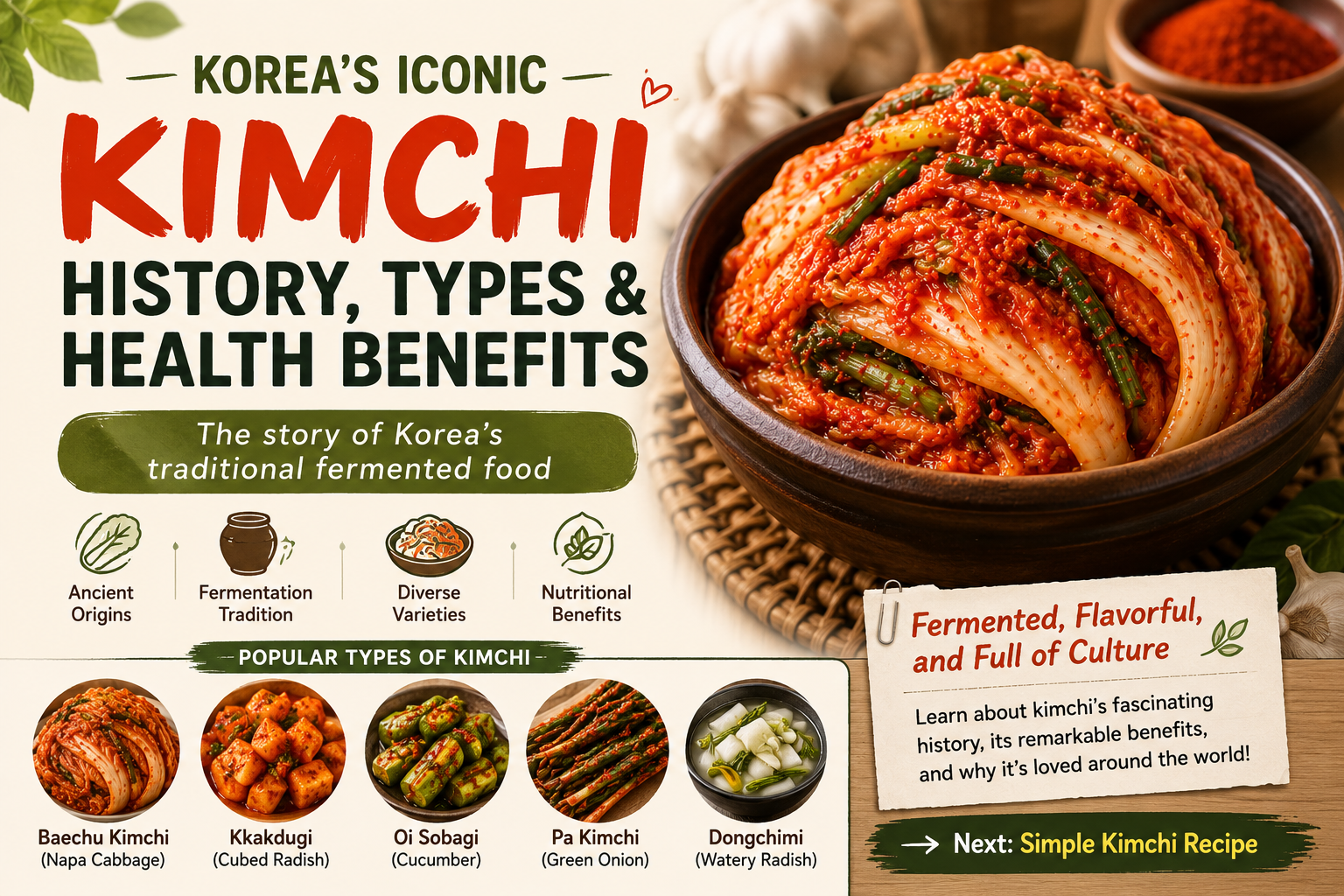
Baechu Kimchi
This is the classic napa cabbage kimchi.
It’s probably the variety most people outside Korea recognize.
Napa cabbage is salted and then seasoned with gochugaru, garlic, ginger, green onion, and other ingredients.
Depending on the recipe and fermentation stage, it can range from relatively mild and crunchy to deeply sour and flavorful.
Kkakdugi
Kkakdugi is made with cubed Korean radish.
Instead of soft cabbage leaves, you get crisp, crunchy pieces of radish.
It’s particularly popular alongside hearty soups and other Korean dishes.
If you love crunchy vegetables, kkakdugi is definitely worth trying.
Oi Sobagi
This is cucumber kimchi.
The cucumber remains relatively crisp, making this variety feel lighter and more refreshing than some heavily fermented cabbage kimchi.
Pa Kimchi
Pa kimchi is made with green onions.
It has a stronger, more aromatic flavor and is a favorite for people who enjoy bold flavors.
Dongchimi
Dongchimi may surprise you because it doesn’t look like the red kimchi most people know.
It is a watery radish kimchi with a refreshing, mildly sour taste.
It’s a great example of why saying “kimchi is always spicy” doesn’t really tell the whole story.
There are many more varieties, and recipes can differ by region, season, and family.
That’s part of the charm of Korean kimchi.
Is Kimchi Actually Good for You?
Now we get to the question that probably comes up most often:
Is kimchi healthy?
There are legitimate reasons why nutrition researchers are interested in kimchi.
First, kimchi is primarily made from vegetables.
Depending on the recipe, ingredients such as cabbage, radish, garlic, ginger, green onion, and red pepper contribute dietary fiber, vitamins, minerals, and various plant compounds.
Then there is fermentation.
During fermentation, microorganisms change the food’s chemical and microbial environment, creating organic acids and other fermentation products.
This combination of vegetables + seasonings + fermentation makes kimchi nutritionally interesting.
But there is an important point here.
Interesting does not mean magical.
What About Kimchi and Gut Health?
You may have heard people call kimchi a “probiotic food.”
There is some scientific basis for the interest.
Lactic acid bacteria are important in kimchi fermentation, and researchers have studied microorganisms isolated from kimchi for their potential effects on human health.
Human studies have also investigated kimchi and digestive health.
However, researchers are still studying exactly how fermented foods interact with the human gut.
So a more accurate way to describe kimchi is:
Kimchi is a fermented food containing microorganisms that are being actively studied for their potential health effects.
That’s much more useful—and much more scientifically responsible—than calling it a miracle food.
Kimchi and Metabolic Health
Researchers have also looked at kimchi consumption in relation to metabolic health and body weight.
Some observational studies have found associations between kimchi consumption and certain metabolic outcomes.
However, an association does not necessarily mean that kimchi itself caused those differences.
This distinction is important whenever we talk about nutrition research.
Food research can be fascinating without turning every interesting result into a health claim.
Don’t Forget the Sodium
Kimchi has plenty going for it nutritionally, but there is something worth keeping in mind.
Salt is an important part of traditional kimchi preparation.
Salt helps draw water from vegetables and plays a role in the texture and fermentation process.
That means some kimchi can contain a significant amount of sodium.
So even though kimchi can be part of a balanced diet, eating very large amounts isn’t necessarily better.
If you already consume a lot of salty foods, it’s worth considering your total daily sodium intake.
In other words, you don’t have to choose between saying “kimchi is healthy” and “kimchi is unhealthy.”
The more realistic answer is:
Kimchi can be a nutritious fermented food, but portion size and your overall diet still matter.
Kimchi Is More Than Food
There is another reason kimchi is so important to Korea.
It isn’t only about what’s inside the jar.
It’s also about the people who made it.
For generations, Korean families prepared large amounts of kimchi before winter. This communal tradition is known as Kimjang.
Families and neighbors would gather together, prepare large quantities of kimchi, share ingredients and recipes, and help one another.
The tradition became a way of passing culinary knowledge from one generation to the next.
UNESCO inscribed Kimjang, making and sharing kimchi in the Republic of Korea, on the Representative List of the Intangible Cultural Heritage of Humanity in 2013.
That is a pretty special way to look at food.
Kimchi isn’t simply something you buy at a supermarket.
For many families, it carries memories.
A particular recipe might remind someone of their mother.
Another might taste like the kimchi their grandmother used to make.
And another might be completely different because it comes from a different region or family.
That’s why two jars of kimchi can taste surprisingly different even when they’re both called “kimchi.”
Why Is Kimchi Served With Almost Every Korean Meal?
This is something visitors to Korea often notice.
You order a meal, sit down, and suddenly several small dishes appear.
One of them is usually kimchi.
It’s not necessarily the main dish.
Instead, it works alongside the rest of the meal.
A bite of rice can taste completely different with kimchi.
Rich grilled meat can be balanced by something spicy and sour.
A bowl of soup can be accompanied by crunchy radish kimchi.
And sometimes kimchi itself becomes part of the main dish.
This is one reason kimchi has become so deeply connected to Korean food culture.
It doesn’t have to be the star.
It simply belongs at the table.
Why Has Kimchi Become So Popular Around the World?
Kimchi was once something most people outside Korea knew very little about.
Today, that’s changing.
Korean restaurants have become more common around the world, and the global popularity of Korean food has introduced more people to kimchi.
K-pop, Korean dramas, travel, and social media have also encouraged people to explore Korean cuisine.
But kimchi’s appeal goes beyond Korean pop culture.
It combines several things that people are increasingly interested in:
vegetables, fermentation, bold flavors, and food traditions.
And unlike some trendy foods, kimchi isn’t a new invention created for the modern health-food market.
Its roots go back centuries.
Kimchi may be having a moment around the world, but in Korea, it’s still everyday food.
That’s perhaps the most interesting part.
So, Should You Try Kimchi?
If you’ve never tried kimchi before, don’t judge Korean kimchi based on one bite.
There are simply too many varieties.
If you like spicy foods, try traditional baechu kimchi.
If you prefer something crunchy, try kkakdugi.
If you like fresh and refreshing flavors, dongchimi might be a better introduction.
And if you enjoy stronger fermented flavors, try well-aged kimchi.
You may discover that kimchi isn’t just one food.
It’s an entire category of flavors.
Final Thoughts: A Small Dish With a Big Story
Kimchi might arrive at your table in a tiny dish.
But its story is anything but small.
Its history is connected to the preservation of vegetables, the development of Korean cuisine, and generations of food traditions.
Its unique flavor comes from fermentation, where lactic acid bacteria and other microorganisms transform the ingredients over time.
Its nutritional value comes from vegetables, seasonings, fiber, micronutrients, and other plant compounds.
And its cultural importance comes from something even simpler:
people sharing food.
Kimchi has been made in Korean homes, shared between neighbors, passed down through families, and served at countless everyday meals.
That’s why calling kimchi simply a “spicy side dish” doesn’t really do it justice.
It is food.
It is fermentation.
It is history.
And for many Koreans, it is also a little taste of home.
Coming Next: A Simple Korean Kimchi Recipe You Can Make at Home
Now that we’ve explored the history, origin, types, fermentation, and potential health benefits of kimchi, you might be wondering one thing:
Can I make kimchi at home?
Yes!
In our next article, we’ll share a simple Korean kimchi recipe for beginners, using ingredients that are relatively easy to find.
We’ll show you how to prepare the cabbage, make the seasoning, mix everything together, and begin the fermentation process.
We’ll also explain what happens after you put your homemade kimchi in the refrigerator.
And here’s a little Korean kitchen secret:
When kimchi becomes very sour after a longer period of fermentation, don’t throw it away.
That deeply fermented kimchi can be perfect for making a warm and comforting bowl of kimchi jjigae, one of Korea’s most beloved home-style dishes.
We’ll save that recipe—and a closer look at the many different types of kimchi—for our next stories.
Your first homemade kimchi may be easier than you think.