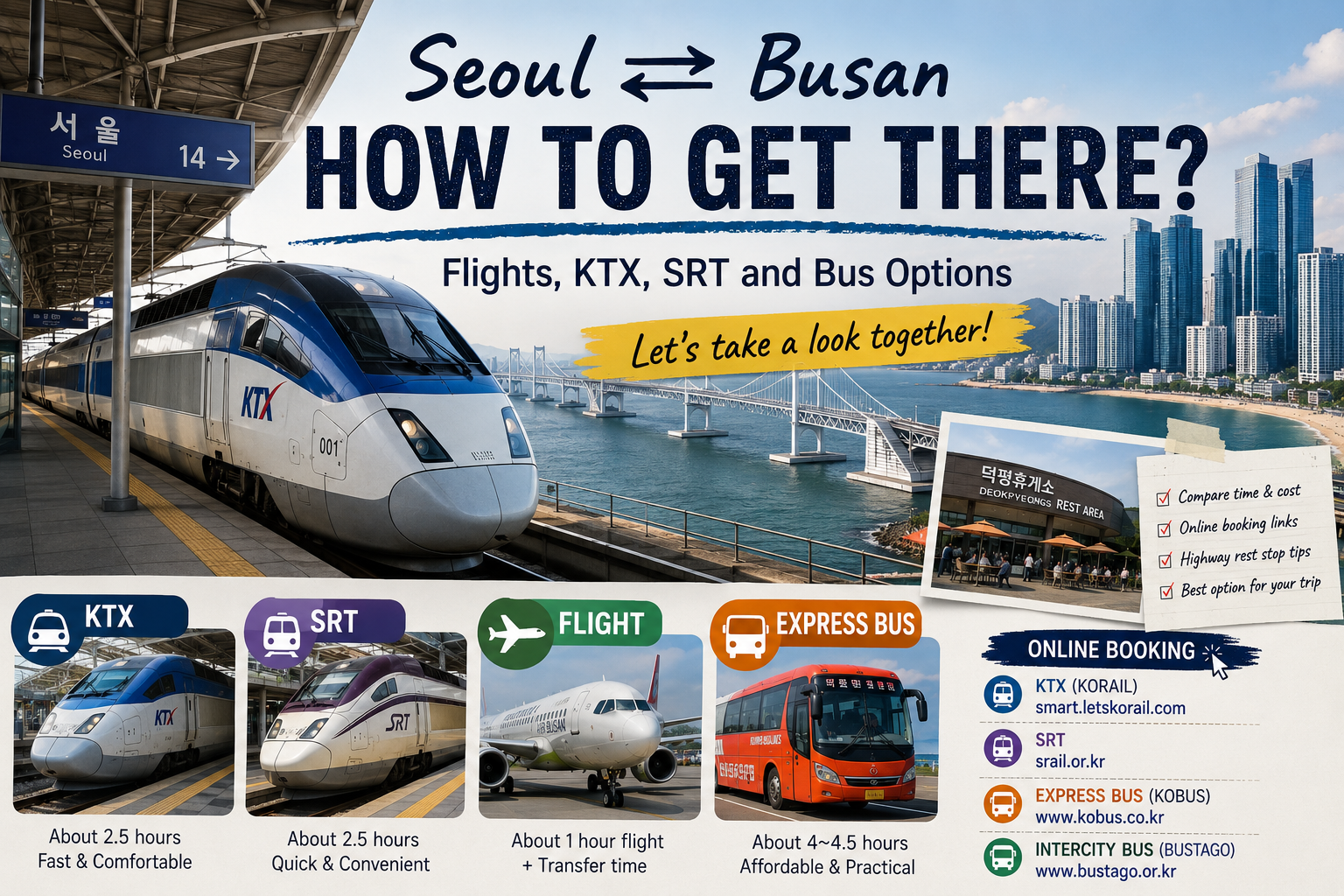
If you are flying to Korea from the U.S. or another country and Busan is your final destination, there are several ways to get there from Incheon International Airport.
At first, it can feel a little confusing. You may have a connecting flight, a train, an express bus, or another domestic flight to choose from.
After traveling between Seoul and Busan many times, I’ve learned that the best option isn’t always the fastest one on paper. It depends on how your international ticket was booked, how much luggage you have, how much time you have, and where you want to spend your trip.
Here is how I would approach it.
If You Booked Your International Flight All the Way to Busan
If you are traveling internationally and booked your ticket with Busan as the final destination, you may have a domestic flight connection from Incheon Airport to Busan included in the same itinerary.
If your ticket and airline qualify for Incheon’s Transit Exclusive Domestic Flight system, you can transfer at Incheon Airport without entering Korea through the normal arrival process.
After your international flight arrives, follow the green Transfer signs, complete the required transfer security screening, and continue to the transfer counter and departure gate. Incheon Airport provides this process for eligible international-to-domestic connections.
This can be a huge time saver.
Instead of leaving the airport, traveling into Seoul, and then taking another train or bus south, you can continue your journey from Incheon directly toward Busan.
However, this is not available for every separate international and domestic ticket. Your airline, ticket, and connecting flight must qualify for the transit procedure. Always confirm the connection with your airline before booking.
If you’re still buying your international ticket and Busan is your final destination, this is the first option I would check.
If You Have Time, Consider Visiting Seoul First
But what if you have several days for your Korea trip?
In that case, I wouldn’t necessarily rush straight to Busan.
One itinerary I really like is:
Incheon Airport → Seoul → Busan
Spend a few days exploring Seoul, then take the train south when you’re ready.
Another option is:
Incheon Airport → Busan → Seoul → Incheon Airport
You can enjoy Busan first, finish your plans there, and then spend the rest of your trip in Seoul before flying home.
Both are easy because Seoul and Busan are well connected by high-speed trains, buses, and domestic flights.
So if you decide to travel from Seoul to Busan—or return from Busan to Seoul—these are the main options.
Seoul to Busan by KTX or SRT
For me, KTX or SRT is usually the first choice.
Korean travelers use these trains constantly, and once you try them, it’s easy to understand why.
They’re fast, comfortable, and most importantly, they take you directly into Busan rather than leaving you at an airport outside the city.
KTX: Seoul Station → Busan Station
SRT: Suseo Station → Busan Station
The high-speed journey takes roughly 2.5 hours, although the exact time depends on the train.
KTX and SRT generally cost more than an express bus, but I think the extra money is often worth it.
You don’t have to arrive at an airport hours early, go through another airport security process, or make another trip from an airport into the city.
When you arrive at Busan Station, you’re already in the city.
For me, city center to city center is the biggest advantage.
If I’m staying around central Seoul, I usually look at KTX from Seoul Station.
If I’m staying around Gangnam or southeastern Seoul, SRT from Suseo can be more convenient.
Tip: You don’t need to buy your KTX or SRT ticket at the station. Both can be booked online in advance, which is especially useful during weekends, holidays, and peak travel seasons.
For KTX, you can search schedules, check fares, and reserve your seat through the official KORAIL website.
Official KORAIL KTX Reservation
For SRT, tickets can also be booked online through the official SRT website. SRT also allows non-members to purchase tickets online.
Official SRT Online Reservation
Flying from Seoul to Busan
You can also fly from Gimpo Airport to Gimhae International Airport, which serves the Busan area.
The flight itself takes only about an hour, and depending on the season, airline, and how early you book, the airfare can sometimes be cheaper than KTX or SRT.
But there’s something important to remember.
The flight time isn’t the total travel time.
You first have to get to Gimpo Airport, arrive early enough for the flight, go through airport procedures, fly to Gimhae, collect your luggage, and then travel from Gimhae Airport into Busan.
If you’re staying somewhere like Haeundae, you have another journey after landing.
Gimhae Airport offers public transportation options including buses and the Busan–Gimhae Light Rail Transit, connecting the airport with different parts of Busan.
So when comparing a flight with KTX, don’t compare only:
Flight: about 1 hour
vs.
KTX: about 2.5 hours
Compare the entire journey.
Sometimes the train ends up being faster—or at least much easier.
When KTX, SRT and Flights Are Sold Out: Take the Bus
This is the option I would keep in the back of my mind, especially during peak travel seasons and holidays.
KTX and SRT can sell out, and domestic flights can also become expensive or fully booked during busy periods.
When that happens, don’t assume you’re stuck.
The express bus is a very practical backup.
Seoul’s major express bus terminals provide routes to Busan, and the Seoul–Busan express bus journey generally takes around 4 to 4.5 hours, depending on traffic and the service.
It is definitely slower than KTX or SRT, but the fare is usually lower, making the bus attractive when you’re traveling on a budget.
Another advantage is that you’re traveling from the city to the city rather than adding another airport transfer.
You leave from a major Seoul bus terminal and arrive at a major Busan bus terminal, where you can continue by subway, bus, or taxi.
The downside is, of course, the travel time.
Four or more hours on a bus can feel long, especially after a busy day of sightseeing.
But there is one thing that can make the journey more interesting, especially if you’re visiting Korea for the first time: Korean highway rest stops.
Long-distance express buses may stop at a highway rest area during the journey, giving passengers a chance to get off, stretch their legs, grab a coffee, or get something to eat.
And Korean highway rest stops are more than just places to use the bathroom.
Many have Korean restaurants, snack stands, cafés, and small shops selling popular Korean foods and snacks.
You might find fish cakes, tteokbokki, roasted sweet potatoes, corn dogs, or other Korean-style snacks.
For a first-time visitor, this can actually become part of the travel experience.
Instead of spending the entire journey staring out the bus window, you get a short break to walk around and try something you might not normally find at an airport or train station.
So yes, the bus takes longer.
But if you have some extra time, a highway rest stop can give you a small taste of everyday Korean travel culture along the way.
Just remember that express buses and intercity buses can use different terminals, so check your departure and arrival terminals carefully when booking.
Tip: You don’t necessarily have to go to the bus terminal to buy your ticket. Express bus tickets can be reserved online, and you can check the departure time, available seats, and fare before you travel. Korea also has a separate reservation system for intercity buses, so it’s important to check which type of bus serves your route.
For express buses, you can use the official KOBUS reservation service:
Official KOBUS Express Bus Reservation
For intercity buses, you can check the official Bustago reservation service:
Official Bustago Intercity Bus Reservation
If you’re traveling during a holiday or peak season, I recommend checking the bus schedules online as soon as you know your travel date. Seats can also sell out, especially on popular Seoul–Busan routes.
Which Way Would I Choose?
If I were planning my own trip, this is how I’d decide:
International ticket already includes an eligible Busan connection:
→ Transfer at Incheon and fly directly to Busan.
I have several days and want to experience Seoul:
→ Stay in Seoul first, then take KTX or SRT to Busan.
I’m starting in Busan and finishing my trip in Seoul:
→ Go to Busan first, then return to Seoul by KTX or SRT.
I want the easiest Seoul–Busan journey:
→ KTX or SRT.
I find a very cheap domestic flight:
→ Compare the entire journey, including transportation to and from both airports.
Everything is sold out during a busy season:
→ Take the express bus and enjoy the unexpected experience of a Korean highway rest stop along the way.
Personally, KTX or SRT is still my first choice for traveling between Seoul and Busan.
But I’ve also learned not to overlook the bus.
Sometimes the best transportation option isn’t the fastest or most expensive one. It’s simply the one that is available, affordable, and takes you where you actually want to go.
And that’s one of the things I like about traveling around Korea. Once you understand the transportation system, moving between Seoul and Busan becomes much less complicated.
Whether you start in Seoul and head south, or start in Busan and work your way north, you have several reliable ways to make the trip.
The important thing is to choose the route that fits your trip, rather than simply choosing the one with the shortest travel time on paper.