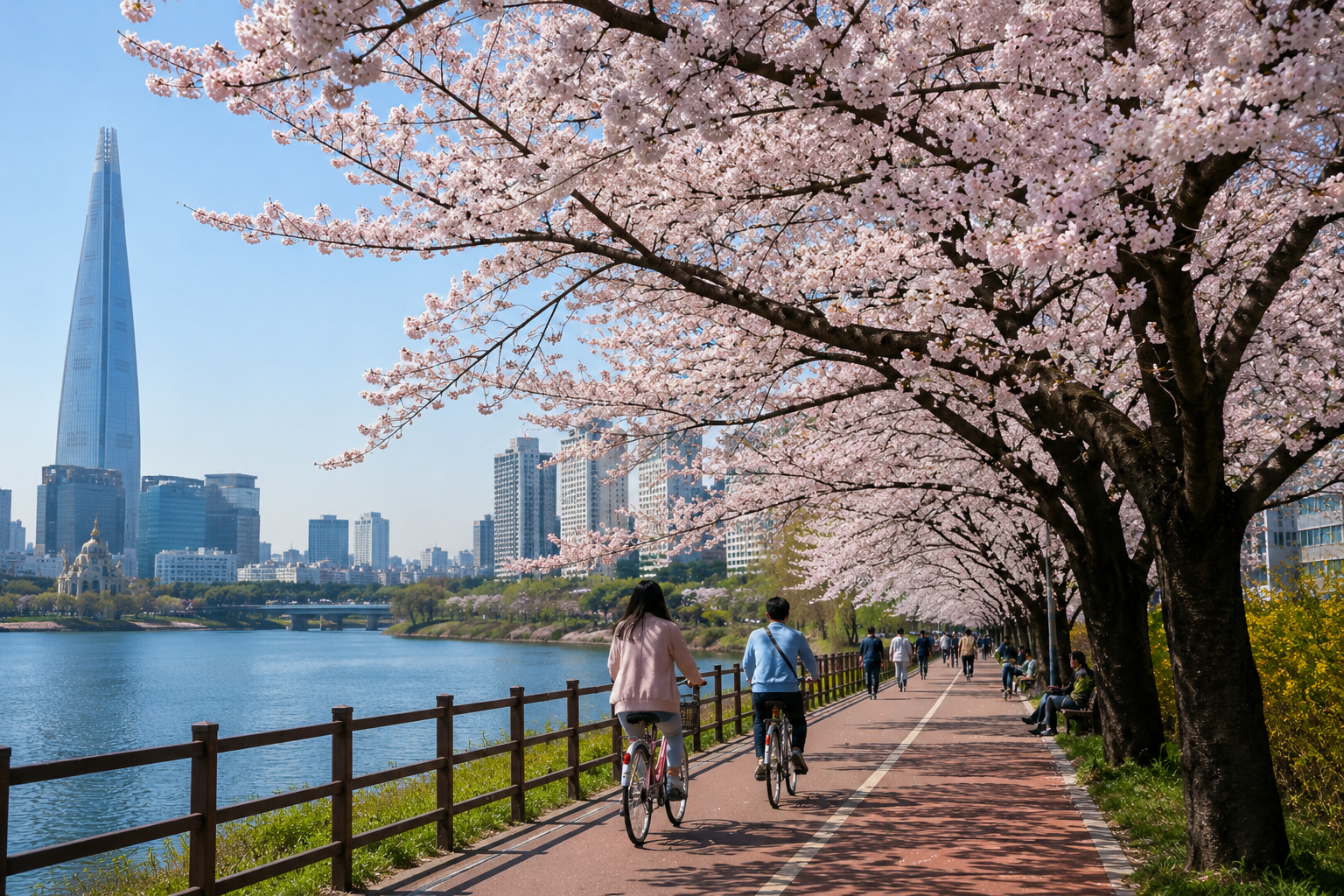
When I think about spring in Korea, I remember the feeling of moving from winter into a season when people finally start spending more time outdoors.
The air is still cool, but the streets begin to feel different. Flowers start appearing, people sit outside again, and weekends become a good excuse to go somewhere.
Some of my favorite spring memories are connected to flowers. I remember riding a bicycle along the cherry blossom road in Yeouido, with pink blossoms overhead and people enjoying the warm afternoon. In Busan, I remember walking along the cherry blossom-lined roads around Dalmaji Hill in the morning and later stopping at a nearby restaurant for brunch.
For me, spring in Korea has always been closely connected with flowers, outdoor activities, and the feeling that the country is waking up again.
Cherry Blossom Season in Korea
Cherry blossoms are one of the biggest reasons international travelers choose spring for a trip to Korea.
The exact timing changes every year depending on the weather, but blossoms generally begin appearing in southern areas before moving north. Late March through early April is often an important period for travelers planning a cherry blossom trip, although exact peak dates can vary from year to year.
Seoul is famous for the cherry blossom trees along the Han River, and Yeouido is one of the most popular places to see them.
I especially remember riding a bicycle through Yeouido during cherry blossom season. Instead of simply walking through the area, cycling along the river with blossoms on both sides made the experience feel completely different. It was one of those simple afternoons that stayed in my memory.
If you visit Seoul during cherry blossom season, Yeouido is worth considering, but it is not the only option. Parks, university campuses, palaces, and residential streets throughout the city can also become beautiful places to see spring flowers.
Busan has its own memorable cherry blossom scenery.
The roads around Dalmaji Hill are particularly beautiful in spring, and the area around Namcheon-dong is also known for its cherry blossom-lined streets. I remember walking around Dalmaji in the morning, enjoying the flowers before stopping at a nearby restaurant for brunch.
That combination is one of the things I like about traveling in Korea. You can spend the morning walking among flowers and then sit down for a casual meal without needing to plan an elaborate itinerary.
More Than Cherry Blossoms
Cherry blossoms may get most of the attention, but spring in Korea is not just about cherry trees.
Depending on when you visit, you can also see plum blossoms, azaleas, canola flowers, and other spring flowers.
Plum blossoms usually appear earlier than cherry blossoms and are especially associated with southern regions such as Gwangyang.
The Gwangyang Maehwa Festival is one of Korea’s best-known spring flower festivals. During the festival season, the hills around Seomjin Village are covered with thousands of white and pink plum blossoms.
Azaleas create another completely different landscape. Mountains and hills can turn pink when the flowers are in bloom, making spring hiking particularly scenic.
Jeju Island is also famous for yellow canola flowers in spring. The combination of yellow fields, blue skies, and volcanic landscapes can make Jeju look completely different from the rest of Korea.
Spring is therefore a good season for travelers who want more than the typical cherry blossom photograph.
You can follow the flowers as they change from plum blossoms to cherry blossoms and then to azaleas and other spring flowers.
Spring Festivals and Local Events
Spring is also one of Korea’s busiest seasons for local festivals.
Many cities and smaller communities organize flower festivals, cultural events, food festivals, and traditional celebrations.
Some well-known examples include the Gwangyang Maehwa Festival, Jinhae Gunhangje Festival, and Gurye Sansuyu Festival.
The Jinhae Gunhangje Festival in Changwon is particularly famous for its large-scale cherry blossom scenery. The city becomes one of the country’s best-known spring destinations, attracting visitors who come specifically to see the flowers.
These local festivals can be a good way to experience a side of Korea that is difficult to discover through a standard Seoul itinerary.
Instead of simply photographing flowers, you can try local foods, walk through traditional neighborhoods, and see how local communities celebrate the arrival of spring.
Spring Hiking in Korea
Spring is also the beginning of Korea’s outdoor hiking season.
Korea is a mountainous country, and hiking is deeply connected with everyday leisure culture. Once the weather becomes milder, mountains and hiking trails begin filling with people again.
Spring hiking can be beautiful because the mountains are changing almost every week. Bare winter branches gradually become green, and wildflowers begin appearing along the trails.
But there is one thing hikers should remember.
As temperatures rise, snakes and other wildlife become active again after the colder months. That does not mean hikers should be afraid of hiking, but it is sensible to stay on marked trails, watch where you step, and avoid touching vegetation or reaching into holes and rocky areas.
If you are visiting Korea specifically for hiking, check the weather and trail conditions before setting out. Some mountain paths can remain slippery or muddy after rain.
For first-time visitors, popular mountains around Seoul can be a convenient introduction to Korean hiking culture without requiring a long journey outside the capital.
Spring Food in Korea
One of the underrated pleasures of visiting Korea in spring is seasonal food.
Spring brings fresh vegetables, wild greens, and seafood to Korean markets and restaurants. If you enjoy food travel, this can be a great time to try ingredients that are closely associated with the season.
Blue crab is one of the notable spring seafoods. In Korea, blue crab is generally considered to be in season from April through June, and female crabs are especially valued during this period because of their roe.
Korea’s west coast, including areas around Incheon, Dangjin, Seosan, Taean, and Anmyeondo Island, is particularly well known for blue crab.
Blue crab can be enjoyed in several ways, including steamed crab, spicy seasoned crab, and ganjang-gejang, a traditional dish made by marinating fresh crab in soy sauce.
Spring is also a good season for jukkumi (webfoot octopus) and dori (flounder). Along Korea’s west coast, these seafoods are particularly associated with spring cuisine.
Boryeong’s Muchangpo Beach, for example, is known for spring jukkumi and flounder dishes, and seasonal seafood festivals are held in the area.
For a traveler who enjoys seafood, spring can therefore be a great excuse to visit Korea’s coastal towns rather than staying only in Seoul.
But seafood isn’t the only seasonal food worth looking for.
Spring brings fresh Korean wild greens and vegetables to local markets. Naengi, a fragrant wild green, is commonly used in soups and seasoned vegetable dishes. Minari is known for its fresh aroma and crisp texture, while dureup, a young spring shoot, is another seasonal ingredient that appears on Korean tables.
If you enjoy food travel, visiting a traditional market in spring can be a simple way to discover what locals are eating that season.
Rather than looking only for famous Korean dishes, ask what ingredients are currently in season. You may find something that never appears on a typical tourist menu.
Buddha’s Birthday and Lantern Festivals
Another unique part of spring in Korea is Buddha’s Birthday.
Buddhism has a long history in Korea, and temples across the country celebrate the occasion with colorful lanterns.
The Lotus Lantern Festival, known in Korean as Yeondeunghoe, is one of the country’s best-known traditional cultural events. Large lantern displays can be seen around temples and city streets, creating a completely different atmosphere after sunset.
You don’t have to be Buddhist to enjoy the festival. For travelers, it is an opportunity to see Korean traditional culture in a very visual and accessible way.
In Seoul, lantern displays and related events can also be found in different neighborhoods depending on the year and event schedule. The Yangjae area in Gangnam, for example, can host evening lantern displays and Buddhist cultural events.
If you want to visit a temple during your trip, Bongeunsa Temple in Gangnam is one of the easiest temples for international visitors to access because it is located in the middle of Seoul.
Other historic temples around Korea can offer a quieter experience, especially if you travel outside the major cities.
Because Buddha’s Birthday follows the lunar calendar, the date changes every year, so check the official festival calendar before planning around it.
What Should You Know About Spring Weather?
Spring sounds perfect, but it is not always warm and sunny.
Early spring can still feel surprisingly cold, particularly in the mornings and evenings. Temperatures can change quickly during the day, so wearing layers is usually more practical than bringing only one heavy jacket.
Another issue travelers should know about is yellow dust and fine dust.
Air-quality conditions can vary during spring, and some days may not be ideal for spending hours outdoors.
If you are visiting Korea in spring, I recommend carrying a mask in your bag, particularly on days when air quality is poor.
Masks are easy to find in Korea, including at pharmacies and Korean supermarkets, so there is no need to pack a large supply before your trip.
Checking Korea’s air-quality forecast before heading out for a full day of sightseeing can help you decide whether it is a good day for hiking, cycling, or other outdoor activities.
Is Spring the Best Time to Visit Korea?
If you want a season that combines comfortable outdoor activities, flowers, local festivals, hiking, seasonal food, and cultural experiences, spring is hard to beat.
It is not always perfectly warm, and you may occasionally have to deal with chilly mornings or poor air quality. But that is part of the character of the season.
You can start the day riding a bicycle beneath cherry blossoms, stop for a bowl of seasonal Korean food, explore a local flower festival, hike through newly green mountains, and finish the evening beneath colorful lanterns.
And perhaps that is the best way to think about spring in Korea.
You don’t come to Korea in spring just to see the flowers. You come to see the country waking up with them.
For travelers looking for a season that gives them a little bit of everything—nature, food, culture, outdoor activities, and local experiences—spring may just be one of the best times to discover Korea.