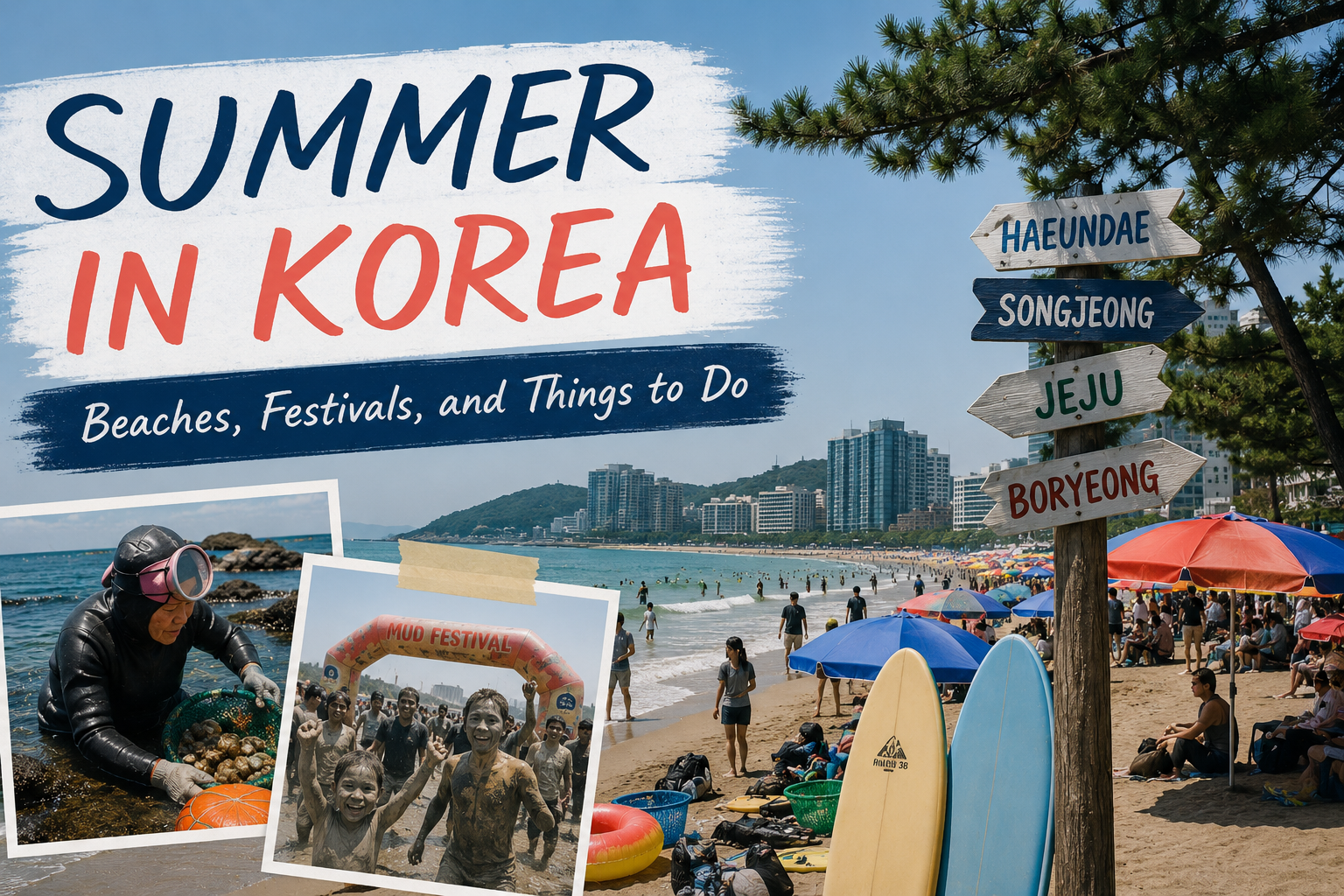
I visited Korea again this summer, and as expected, it was hot and humid. But that is also what makes summer in Korea so lively. Beaches were busy, water activities were everywhere, and there seemed to be something happening outdoors almost every weekend.
This summer, I spent some time in Jeju Island, where I did more than simply visit the beach. I joined a haenyeo experience program, which gave me a chance to learn about the traditional culture of Jeju’s female divers and experience a small part of their daily world.
I also remember visiting Busan in the summer two years ago and trying surfing at Songjeong Beach. I wasn’t an experienced surfer, but getting into the water and trying to catch a wave was one of those simple travel experiences that I still remember.
Those experiences made me realize that summer in Korea isn’t only about sitting on a beach.
You can swim, surf, explore islands, visit seafood markets, join local festivals, watch nighttime performances, or simply spend an evening outside with friends.
And because Korea is surrounded by water on three sides, the summer experience can be very different depending on which coast you visit.
Korea’s Three Coasts: West, East, and South
Korea is a peninsula surrounded by water on three sides, and its coastline is often broadly described as the West Coast, East Coast, and South Coast.
Each area has a different landscape and a different kind of summer experience.
The West Coast is known for tidal flats, mud, seafood, and coastal experiences such as shellfish gathering.
The East Coast is known for relatively clear, deep-looking waters, beaches, surfing, and seafood markets.
The South Coast has numerous beaches, small islands, harbors, and scenic coastal landscapes.
This makes summer a particularly good season for exploring beyond Seoul.
West Coast Korea: Mud, Tidal Flats, and Seafood
The West Coast has a very different character from the beaches of Busan or Jeju.
Because of its large tidal range, parts of the West Coast are famous for tidal flats and mud-based experiences.
One of the best-known summer events is the Boryeong Mud Festival in Chungcheongnam-do.
The festival takes place around Daecheon Beach and turns Boryeong’s mud into the centerpiece of a large summer event. Visitors can participate in mud activities, water attractions, performances, and other outdoor programs.
I have experienced the festival myself, including a visit with my children, and watching them enjoy it was one of my favorite memories.
They loved getting covered in mud, playing in the water, and joining the activities. It was one of those family experiences where everyone ended up laughing and getting messy together.
That is also what makes the festival different from simply visiting a beach. You are not just watching something—you are actually part of it.
One practical tip, especially if you are bringing children: the festival area can become very slippery because of the mud and water.
I recommend wearing non-slip sandals or water shoes with good traction rather than smooth-soled flip-flops. Shoes that stay securely on your feet can also make it easier to move around during the activities.
If you are already visiting the West Coast, you can also look for opportunities to experience Korea’s tidal flats.
Depending on the location and season, visitors may be able to participate in shellfish-gathering experiences, where they walk across exposed tidal flats and look for clams and other shellfish.
These activities are tide-dependent, so always check the local schedule and visitor information before going.
For a traveler, the West Coast can therefore offer something very different from a typical beach vacation:
mud festival → tidal flats → seafood → sunset
East Coast Korea: Clear Water, Surfing, and Seafood
The East Coast has a completely different atmosphere.
The coastline faces the open East Sea, and many beaches are known for relatively clear water, deeper coastal scenery, and long sandy stretches.
This is also where you will find some of Korea’s best-known surfing destinations.
I experienced this myself in Songjeong, Busan, two summers ago.
I had wanted to try surfing for a while, so I decided to give it a try while I was there. The experience was much more fun than I expected. Even though I wasn’t particularly good at it, simply being in the water and trying to stand on the board made the day memorable.
Songjeong is one of the places in Busan where visitors can find surfing lessons and rental services during the warmer months.
Beyond surfing, the East Coast is also a good destination for seafood lovers.
Coastal cities and towns have traditional seafood markets where you can see the day’s catch and try local dishes.
So if you enjoy a combination of beach + surfing + seafood, the East Coast is worth considering.
South Coast and Jeju: Beaches, Islands, and Coastal Experiences
The South Coast offers yet another kind of summer landscape.
This region has countless small islands, fishing villages, harbors, beaches, and winding coastal roads. Some areas feel much quieter than the major beach destinations.
And then there is Jeju Island.
I visited Jeju this summer, and one of the highlights of my trip was participating in a haenyeo experience program.
The haenyeo are Jeju’s traditional female free divers, known for harvesting seafood from the sea without relying on modern breathing equipment.
For me, the experience was interesting because it wasn’t simply another tourist attraction.
It introduced me to a part of Jeju’s traditional relationship with the ocean.
Of course, a summer trip to Jeju can also include the more familiar activities—swimming, beaches, coastal walks, cafés, seafood, and island sightseeing.
But I would recommend adding at least one experience connected to the island’s local culture.
That can make a beach trip feel much more meaningful.
Busan in Summer: Beaches, Water Events, and Summer Nights
If there is one major Korean city that feels especially alive during summer, I would choose Busan.
I have lived in Busan before, and summer is when the city seems to change.
There are several major beaches, including Haeundae, Gwangalli, Songjeong, Songdo, and Dadaepo. During the summer months, these coastal areas become gathering places for swimming, water activities, festivals, performances, and evening events.
Haeundae Beach is probably the beach most familiar to international visitors, but Busan has much more coastline to explore.
Songjeong is particularly well known for surfing, while other beaches offer different atmospheres and activities.
Busan also hosts a variety of summer events. Depending on the year, visitors may encounter large-scale music and water events, beach festivals, performances, and nighttime programs.
The Busan Sea Festival is one of the city’s signature summer events, with programs connected to the city’s major beaches.
Another popular nighttime experience is the Gwangalli M Drone Light Show, where large-scale drone performances take place over Gwangalli Beach on scheduled evenings.
Event dates and programs can change each year, so checking the official Busan tourism calendar before your trip is important.
For me, that combination is what makes Busan particularly fun in summer.
You can spend the afternoon at the beach, have seafood for dinner, and then stay outside after sunset for a performance or nighttime event.
It feels less like a sightseeing schedule and more like simply being part of the city.
Summer Festivals Beyond the Beaches
One of the reasons I like traveling in Korea during summer is that you don’t have to stay in the major tourist cities.
Regional festivals can take you to smaller cities and coastal communities that you might otherwise skip.
The Boryeong Mud Festival is one example, but Korea has many other seasonal events involving food, music, water, local traditions, and regional culture.
When planning a summer trip, I recommend checking the official tourism calendar for the region you are visiting rather than looking only at major attractions.
Sometimes the most memorable part of a trip is an event you didn’t originally know existed.
Summer Food: Seafood and Coastal Markets
Summer is also a good time to explore Korea through food.
Because so much of Korea’s summer activity revolves around the coast, seafood naturally becomes part of the experience.
Depending on the region and season, you may find grilled shellfish, raw seafood dishes, seafood stews, grilled fish, noodles, and other regional specialties.
One of my favorite things to do when visiting coastal areas is to walk through a local seafood market before deciding what to eat.
It feels different from ordering seafood at a restaurant in Seoul because you can actually see what is being sold locally.
Jeju, Busan, and the coastal towns along the East and South coasts are particularly good places to combine sightseeing with seafood experiences.
Summer Nights in Korea
Another thing international visitors may not expect is how much Koreans enjoy being outside after sunset during summer.
Because daytime temperatures can be uncomfortable, evenings often become the best time to enjoy outdoor areas.
Beaches remain busy after dark, cafés stay open late, restaurants fill up, and parks and waterfront areas can become lively gathering places.
In cities such as Busan, you can spend the evening near the ocean rather than returning to your hotel after dinner.
For me, this is one of the things that gives Korean summer its particular energy.
The day doesn’t necessarily end when the sun goes down.
What Should You Know About Korean Summer Weather?
There is one thing you should definitely prepare for: heat and humidity.
July and August can be particularly hot, and Korea’s summer also overlaps with the rainy season. Sudden heavy rain can occur, and weather conditions can change quickly.
Typhoons can also affect Korea during the summer, although their timing and impact vary each year.
If you are planning outdoor activities, especially surfing, hiking, swimming, or island trips, check the weather forecast before heading out.
It is also a good idea to carry:
- sunscreen
- a hat
- sunglasses
- water
- lightweight clothing
- a compact umbrella or rain jacket
And if you are visiting during the peak summer vacation period, expect popular beaches, highways, airports, and transportation hubs to be much busier.
Is Summer a Good Time to Visit Korea?
Summer isn’t the easiest season if you dislike heat and humidity.
But if you enjoy beaches, water activities, surfing, seafood, festivals, islands, and lively evenings, summer can be one of the most exciting times to experience Korea.
You can try surfing in Busan, explore tidal flats on the West Coast, experience a mud festival, visit seafood markets, explore the islands of the South Coast, or take part in a cultural experience in Jeju.
And you don’t have to choose just one.
That may be the best thing about summer in Korea.
You can spend the morning in the ocean, eat seafood for lunch, join a local event in the afternoon, and finish the day watching the city lights by the water.
For travelers who want a summer trip that combines nature, food, culture, adventure, and local experiences, Korea can offer much more than a traditional beach vacation.