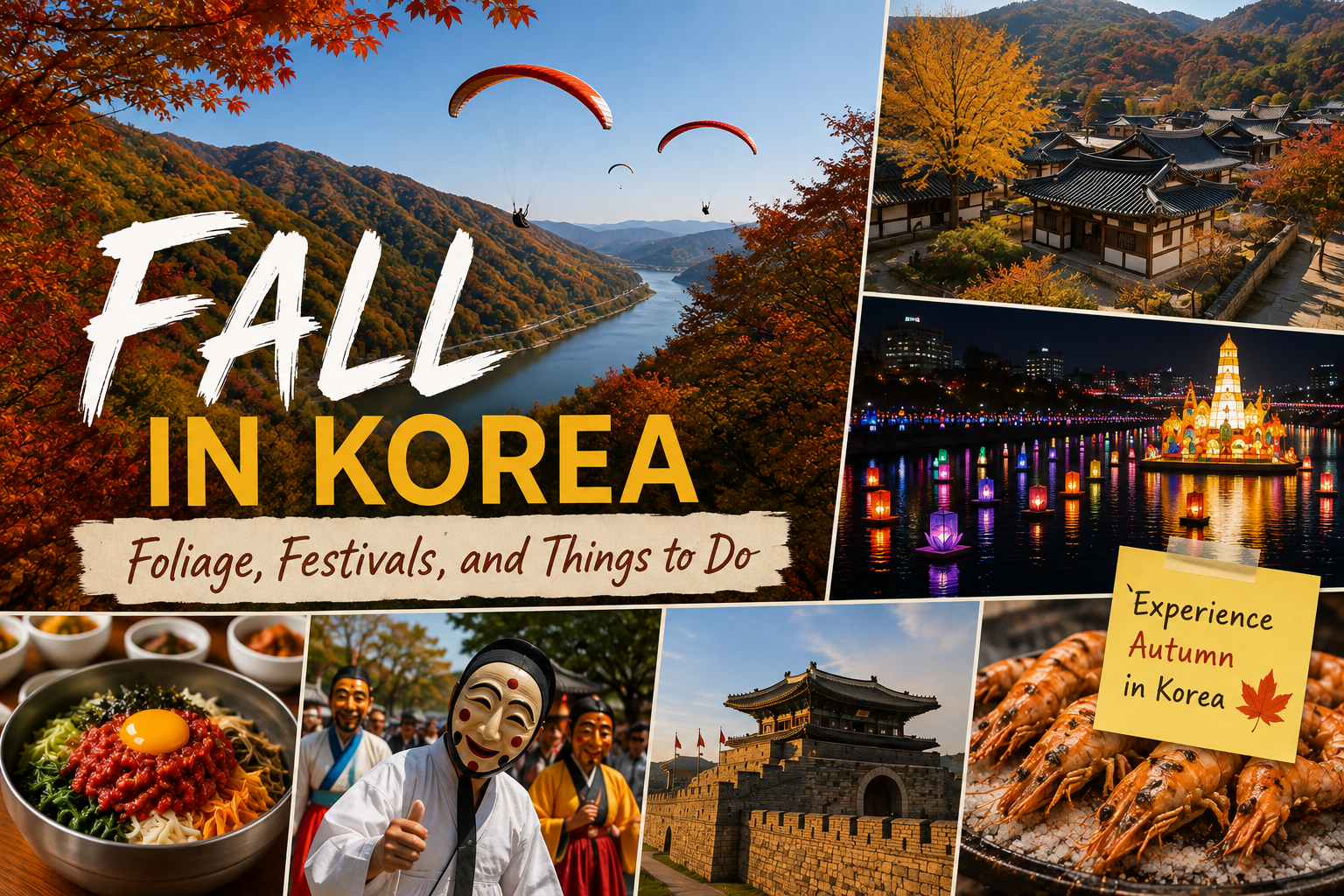
It is also a season when outdoor activities become more enjoyable. Korea has many golf courses, hiking trails, and scenic destinations, while farms and markets begin to fill with the results of the year’s harvest.
For me, Autumn in Korea is not just about looking at colorful leaves. Some of my favorite memories are connected to local festivals, regional food, and experiences that you would probably miss if you stayed only in Seoul.
Autumn Foliage in Korea
From October into November, mountains and parks across Korea gradually turn shades of red, orange, and yellow. The exact timing varies by region and year, so it is worth checking the foliage forecast before planning a trip.
You do not always need to travel far from Seoul to enjoy autumn colors. Places such as Bukhansan National Park, Nami Island, and the palaces and parks around Seoul can offer beautiful fall scenery.
For a more dramatic mountain landscape, however, destinations such as Seoraksan, Odaesan, Naejangsan, and Jirisan are popular choices.
One thing I enjoy about Korean autumn is how quickly the scenery changes. A familiar mountain or neighborhood can look completely different only a few weeks later.
Danyang: Watching Paragliders Over Autumn Mountains
One of my most memorable experiences connected to Korea’s mountains happened in Danyang.
When I was a student, I had the opportunity to volunteer at a paragliding competition there. I remember looking up at the sky and seeing colorful paragliders floating above the mountains.
The green mountains were beginning to take on autumn colors, while the sky was filled with gliders in different colors. From below, it almost looked as though someone had embroidered the sky above the mountains.
Danyang is already known for its dramatic mountain and river scenery, but seeing dozens of paragliders flying above the landscape made the experience completely different.
You don’t necessarily have to participate in paragliding to enjoy it. Even watching from the ground can be an unforgettable part of an autumn trip.
Autumn Festivals: Experience Korea Beyond Seoul
Fall is one of the best seasons to explore Korea’s regional festivals.
Many cities celebrate the harvest season with food festivals, cultural performances, traditional events, and nighttime celebrations.
Andong: Traditional Korea and Mask Dance
Andong is one of the places I recommend if you want to experience traditional Korean culture in a more direct way.
The city is famous for preserving traditional Korean heritage, and the Andong Mask Dance Festival is one of its best-known cultural events.
One of the things I enjoyed about visiting Andong was watching traditional mask dance performances from close by. Instead of seeing Korean traditional culture only inside a museum, you can watch performers right in front of you and experience the energy of the performance.
I have also stayed at a traditional-style hanok guesthouse near the festival area. Sleeping in a traditional ondol room was another memorable experience. The heated floor system gives you a small taste of how Koreans traditionally lived and slept.
Andong is also a good place to try regional food.
One local specialty is Heotjesabap, a dish traditionally associated with Korean ancestral ritual food but served as an everyday meal. If you are adventurous with food, Andong is also one of the places where you may encounter dishes featuring shark meat, which is a regional food tradition that may be unfamiliar to many international visitors.
Jinju: Lanterns Along the Namgang River
Another autumn festival I remember is the Jinju Namgang Yudeung Festival in Jinju.
Jinju is connected to the historical story of Nongae, a Korean historical figure associated with the Jinju area. During the festival, thousands of lanterns illuminate the Namgang River, creating a spectacular nighttime landscape.
I remember the atmosphere being especially impressive after dark. The reflection of the lanterns on the river made the entire area feel almost dreamlike.
And if you make the trip to Jinju, don’t leave without trying Jinju-style yukhoe bibimbap. It is a regional version of one of Korea’s best-known dishes and makes a great food stop during a festival visit.
Suwon: History, Architecture, and Korean BBQ
Suwon Hwaseong Fortress is another good autumn destination.
The UNESCO-listed fortress provides a chance to walk through Korean history while enjoying the cooler fall weather.
After exploring the fortress, you can try Suwon galbi, the city’s famous grilled beef ribs. For me, combining a cultural site with a regional specialty is one of the easiest ways to make a day trip more memorable.
Autumn Harvest and Seasonal Food
Fall is also the season when the results of the year’s farming begin appearing everywhere.
Korean markets become filled with seasonal fruits such as apples, Korean pears, persimmons, grapes, and chestnuts.
It is also a great time to visit local markets or agricultural areas because seasonal produce is often at its best.
And if you enjoy seafood, autumn has something special for you.
Along Korea’s west coast, fall is associated with Daehar (large shrimp), and local seafood festivals celebrate the season.
I have been to a Daehar salt-grilled shrimp festival, and one thing I remember clearly is how many people came for it. The smell of shrimp grilling over salt fills the festival area, and the crowds can be surprisingly large.
If you plan to visit one of these seafood festivals, especially on a weekend, expect crowds and allow extra time.
Chuseok: Korea’s Biggest Traditional Holiday
After the regional festivals and autumn activities, there is one more important part of Korean fall that international travelers should know about: Chuseok.
Chuseok is one of Korea’s biggest traditional holidays and is sometimes compared with Thanksgiving in the United States because it is strongly associated with family gatherings, returning to one’s hometown, and sharing food.
However, Chuseok has its own Korean history and traditions, so it is not simply a Korean version of Thanksgiving.
During the holiday period, millions of people travel across the country to visit their families.
This creates one of the busiest travel periods of the year.
Highways can become heavily congested, and trains, buses, and domestic flights can sell out quickly. Major transportation hubs can also become extremely busy.
If your trip overlaps with Chuseok, book transportation as early as possible and expect longer travel times.
For travelers who happen to be in Korea during Chuseok, it can also be an interesting opportunity to see how an important Korean family holiday affects everyday life.
Is Fall a Good Time to Visit Korea?
Absolutely—especially if you want more than the typical Seoul sightseeing itinerary.
Fall gives you comfortable weather, colorful mountains, outdoor activities, seasonal food, regional festivals, traditional culture, and opportunities to explore smaller Korean cities.
You might spend the morning hiking through autumn foliage, watch paragliders over Danyang in the afternoon, eat regional food at a local festival, and finish the evening surrounded by lanterns along a river.
That combination is what makes autumn in Korea special.
If spring is the season when Korea wakes up, fall is when Korea shows off.