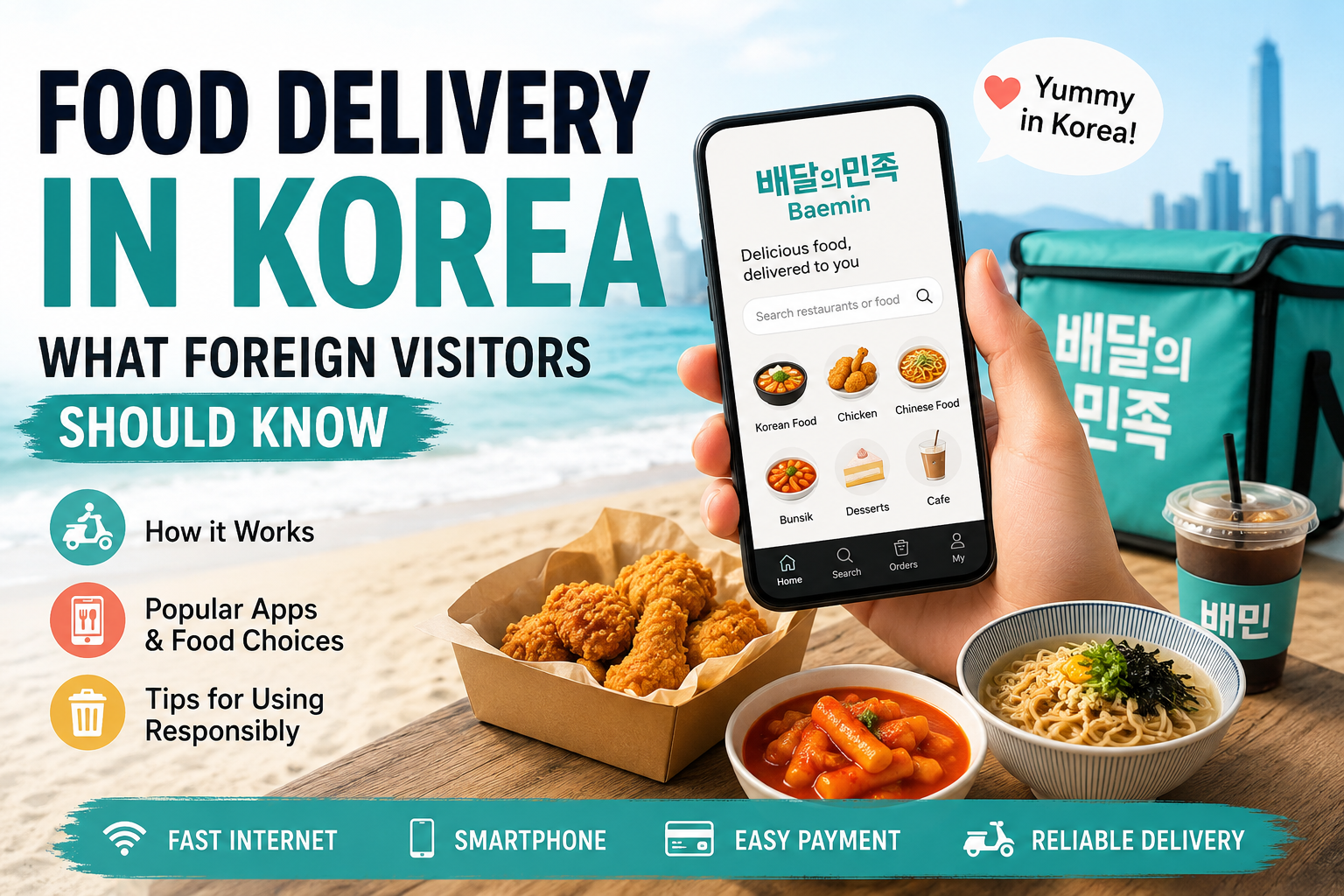
Have you ever been swimming at a Korean beach, suddenly felt hungry, and wondered if you could order food without leaving the beach?
In Korea, depending on the location and restaurant, you may be able to do exactly that.
Food delivery is not simply a service Koreans use when they do not want to cook. It has become part of everyday life, and for foreign visitors, opening a Korean delivery app can be an interesting way to discover how people eat in Korea.
What makes it even more interesting is the variety of food you can see before you order anything.
Open a Korean Delivery App and Discover Korean Food
One of the first things I recommend doing after arriving in Korea is checking out a Korean food delivery app.
You do not even have to order food.
Just open the app and browse.
A foreign visitor may expect to see familiar choices such as pizza, burgers, or fried chicken. But a Korean delivery app can show a much wider selection of local food.
Depending on the area, you may find kimchi jjigae, bibimbap, tteokbokki, naengmyeon, gukbap, jokbal, bossam, Korean-style street food, desserts, and café drinks.
Some of these dishes may be completely unfamiliar if you have never visited Korea before.
That is what makes browsing a Korean delivery app surprisingly interesting.
You can look at food photos, read menus, compare prices, check restaurant reviews, and see what people can order in the neighborhood where you are staying.
Instead of visiting several restaurants just to see what Korean food looks like, you can explore many different options from your phone.
In that sense, a Korean food delivery app can be more than a way to order dinner.
It can be a window into Korean food culture.
Baemin: One of Korea’s Most Recognizable Delivery Apps
One of the names you are likely to encounter is Baemin, short for Baedal Minjok.
If Uber is a familiar name in the United States for app-based transportation and food delivery services, Baemin is one of the best-known names in Korea’s food delivery market.
Baemin is operated by Woowa Brothers, which describes Baedal Minjok as a platform connecting customers, restaurant owners, and riders. The company launched Baedal Minjok in 2010 and introduced its mobile payment service in 2012.
The basic process is simple:
Choose a restaurant → Select your food → Enter the delivery location → Pay → Receive the order
For someone visiting Korea for the first time, the interesting part is how naturally this process fits into everyday life.
You might order food at your hotel after a long day of sightseeing.
You might order fried chicken for a group of friends.
Or, depending on the location and restaurant, you may be able to order food while spending time outdoors.
Why Is Food Delivery So Common in Korea?
There is no single reason.
Korea has widespread smartphone use, digital payment systems, high-speed internet, extensive mobile connectivity, and a large delivery industry.
The country’s digital infrastructure also provides an important foundation. According to the OECD, fiber accounted for about 90% of fixed broadband connections in Korea in 2024, one of the highest shares among OECD countries.
But fast internet alone does not create a food delivery culture.
Several systems have to work together.
The customer uses a smartphone to place the order and make a payment.
The restaurant receives the order and prepares the food.
The delivery rider uses navigation and mobile connectivity to find the destination.
The platform connects these parts of the process.
This combination of digital technology, restaurants, payment systems, and physical delivery has helped make food delivery a normal part of everyday life in Korea.
What About Ordering Food at the Beach?
This is where things can become especially interesting for foreign visitors.
Imagine spending the afternoon swimming at a Korean beach.
You are hungry, but you do not want to pack everything up and leave.
You open a delivery app and start browsing.
You find Korean fried chicken.
Then tteokbokki.
Then noodles.
Then perhaps a café selling iced drinks and desserts.
Suddenly, you are not just ordering food.
You are browsing Korean food culture from your phone.
However, there is an important practical detail.
A restaurant showing up in a delivery app does not necessarily mean that the driver will bring the food directly to wherever you are sitting on the beach.
The delivery location needs to be accessible.
Depending on the location, you may need to meet the driver at an entrance, parking area, nearby building, landmark, or another designated location.
This is especially important at large beaches, parks, festivals, and other crowded outdoor areas.
Before ordering, check the delivery instructions carefully and choose a location that the driver can easily find.
What Foreign Visitors Should Know Before Using a Korean Delivery App
If you want to try Korean food delivery during your trip, it is better to prepare before you are hungry.
After arriving in Korea, check which delivery apps are available to you and see whether you can complete the registration process.
Some services may require a Korean phone number, local payment method, or additional verification. Requirements can vary between platforms and may change over time, so check the current requirements of the app you plan to use.
Even if you cannot place an order immediately, browsing the app can still be useful.
You can discover restaurants near your hotel, check typical prices, look at food photos, and save ideas for meals you want to try later.
For a first-time visitor, this can be much easier than trying to understand an unfamiliar menu after sitting down at a restaurant.
One More Important Tip: Clean Up After Eating
If you order food outdoors, remember that your responsibility does not end when you finish eating.
Do not leave food containers, cups, or leftover food where you ate.
Korea has an established waste separation and recycling system. The Korean Ministry of Environment explains that Korea’s waste-management system includes separate disposal of recyclable waste as well as separate management of general and food waste.
However, the exact disposal instructions can vary depending on the location.
You may see different bins or collection areas for food waste, plastics, paper, cans, and other materials.
Check the signs and instructions around the trash and recycling bins before throwing anything away.
This is particularly important when eating at beaches, parks, or other public spaces.
For a foreign visitor, it may seem like a small detail, but properly disposing of your waste is part of using Korean public spaces responsibly.
Enjoy the food, enjoy the view, and leave the area clean for the next person.
Why Korean Food Delivery Is Worth Experiencing
The most interesting thing about Korean food delivery is not simply that food can be delivered quickly.
It is how closely the service is connected to everyday life.
A delivery app can show you foods you have never heard of.
It can help you discover restaurants in the neighborhood.
It can make it easier to order food after a long day of sightseeing.
And, depending on the location, it may even allow you to enjoy a meal while spending time outdoors.
For foreign visitors, this makes Korean food delivery more than a convenience.
It is a practical way to experience a small part of everyday Korean life.
So when you arrive in Korea, open a delivery app and browse for a few minutes.
Look at the photos.
Check the menus.
Notice how many different types of Korean food are available.
You might discover a dish you have never heard of—and that dish could end up becoming one of the most memorable meals of your trip.
Just remember three things: check the delivery location, follow local waste-sorting instructions, and enjoy exploring Korean food.