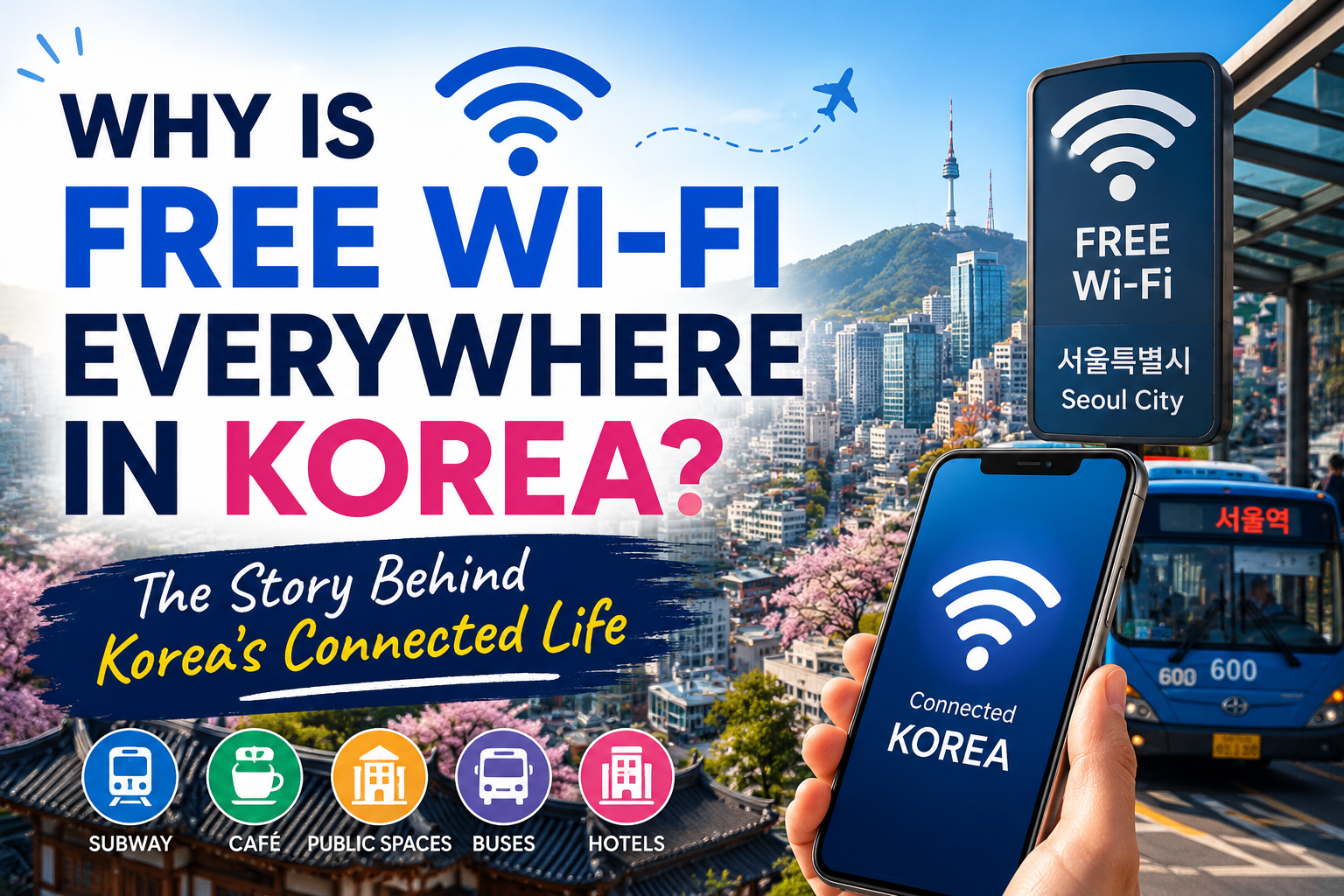
If you are visiting South Korea for the first time, you may notice something surprisingly convenient: free Wi-Fi is often easy to find.
You may encounter public Wi-Fi at transportation facilities, public spaces, cafés, shopping areas, and other places where people spend time. For travelers who normally rely on mobile data or paid internet services, this can make getting around Korea feel much easier.
But is free Wi-Fi really everywhere in Korea?
Not literally. Wi-Fi availability varies by location, and some networks require passwords, registration, or acceptance of terms. However, South Korea has developed a highly connected digital environment in which public Wi-Fi and high-speed mobile networks are widely available.
The story behind this connectivity is not simply about technology. It is also about long-term investment in telecommunications, government-supported public Wi-Fi, widespread smartphone use, and a society where digital services have become part of everyday life.
Korea’s Long History of High-Speed Internet
South Korea’s reputation for fast internet has developed over several decades.
During the early expansion of the internet, Korea invested heavily in broadband infrastructure and information technology. High-speed internet became increasingly common in homes, businesses, schools, and public institutions.
That early investment helped create an environment where internet access became a normal part of everyday life rather than something reserved for certain locations.
The country’s telecommunications infrastructure remains highly developed today.
According to the OECD, Korea had 47.3 fixed broadband subscriptions per 100 inhabitants in 2024, placing it among the countries with the highest broadband penetration in the OECD. The OECD also reported that 5G accounted for 55% of mobile broadband subscriptions in Korea, compared with 37% across the OECD countries with available data.
These numbers help explain why visitors may experience Korea as a highly connected country.
Public Wi-Fi Has Been Supported by Government Policy
Private businesses are only part of the story.
South Korea has also invested in public Wi-Fi as a way to expand internet access in public spaces.
The Ministry of Science and ICT reported that the country added more than 10,000 public Wi-Fi installations in 2020, including locations such as bus stops and other public facilities. This increased the number of public Wi-Fi locations from approximately 18,000 in 2019 to around 28,000 in 2020.
This type of investment helped make Wi-Fi available in places where people naturally spend time.
For visitors, that can mean encountering public internet access while using transportation, visiting a public facility, or exploring a busy area.
Seoul Is Focusing on Better Public Wi-Fi
Public Wi-Fi infrastructure is also continuing to evolve.
In April 2026, the Seoul Metropolitan Government announced that it was shifting its public Wi-Fi strategy from simply expanding the number of installations toward improving speed, stability, and overall quality.
According to the city government, Seoul operates approximately 35,318 public Wi-Fi units across locations including buses, bus stops, parks, traditional markets, and welfare facilities.
The city also reported that its public Wi-Fi service is used by approximately 4.21 million people per day.
As part of its 2026 plan, Seoul is investing KRW 2.4 billion to replace 2,020 older Wi-Fi units. The city also plans to introduce Wi-Fi 7 at major facilities and bus stops across all 25 districts and expand high-quality public Wi-Fi zones in areas such as Myeong-dong, Seongsu, and Hangang River parks.
For travelers, this is an interesting development because it shows that public Wi-Fi is being treated as an ongoing infrastructure service rather than a one-time project.
Why Is Internet Access So Important in Korea?
To understand Korea’s Wi-Fi environment, it helps to look at how people use digital technology.
Smartphones in Korea are used for much more than communication.
People rely on mobile devices for navigation, transportation, shopping, food delivery, entertainment, reservations, banking, messaging, and many other everyday activities.
Research from the Korea Information Society Development Institute, or KISDI, supports the importance of smart devices in Korean daily life.
The institute’s 2025 Korean Media Panel Survey covered 3,956 households and 8,411 individuals and found continued growth in the ownership and use of portable smart devices, including smartphones, tablets, and laptops. The survey also examined the continued use of OTT services, social media, and instant messaging.
When so many daily activities depend on connected devices, reliable internet becomes increasingly important.
Korean Cafés Help Make Wi-Fi Feel Normal
Another reason travelers often notice Wi-Fi in Korea is the country’s café culture.
A café in Korea can be much more than a place to buy coffee.
Students may study there for several hours. Remote workers may use cafés as temporary workspaces. Friends may meet and stay for a long conversation. People may use laptops and tablets while enjoying a drink.
Because customers often spend considerable time in cafés, Wi-Fi has become a useful and expected service at many establishments.
For travelers, this can be particularly convenient.
You can sit down with a coffee, connect to Wi-Fi, check a subway route, translate a Korean menu, research your next destination, or make a reservation.
In this sense, the Korean café has become part of the country’s broader connected lifestyle.
Public Transportation and Wi-Fi
Transportation is another area where visitors may encounter public connectivity.
South Korea has invested in Wi-Fi access on public transportation and at transportation-related facilities.
The Ministry of Science and ICT’s Digital New Deal initiatives included expanding free Wi-Fi at public locations, including bus stops.
For travelers, this can be useful because transportation is one of the most important parts of exploring Korea.
You may need internet access to check directions, translate information, find the correct bus or subway route, or contact someone while moving between destinations.
Having access to Wi-Fi in transportation environments can reduce some of the challenges that come with navigating an unfamiliar country.
Free Wi-Fi Does Not Mean Unlimited or Universal Wi-Fi
It is important to keep expectations realistic.
Although free Wi-Fi is widely available in many parts of Korea, it is not guaranteed everywhere.
You may encounter:
- Networks that require a password
- Café Wi-Fi available only to customers
- Hotel networks requiring a room number or login
- Public networks that require terms and conditions
- Areas with weak or unavailable signals
The quality of a Wi-Fi connection can also vary depending on location and network congestion.
So, if you are traveling to Korea, it is better to think of free Wi-Fi as a convenient resource rather than something you should depend on exclusively.
Should Travelers Get a SIM Card or eSIM?
For most international travelers, having mobile data is still a good idea.
A Korean SIM card or eSIM can provide connectivity when you are walking outdoors, traveling through areas without public Wi-Fi, or moving between locations.
Mobile data is particularly useful for navigation.
Imagine walking through a neighborhood in Seoul and suddenly needing to check a map, translate a Korean sign, find a restaurant, or look up public transportation.
In situations like these, having your own mobile connection can be much more convenient than searching for a Wi-Fi network.
A practical approach is to use mobile data as your primary connection and reliable Wi-Fi as a supplement.
Is Public Wi-Fi Safe?
Convenience should not replace basic internet security.
Not every public Wi-Fi network should automatically be trusted.
When connecting to public Wi-Fi, check the network name carefully and, when possible, confirm the official network with the business or facility providing it.
It is also wise to avoid entering highly sensitive financial information through an unfamiliar or unsecured network.
Free Wi-Fi can be extremely useful for checking maps, reading information, messaging friends, and browsing websites. For sensitive transactions, however, using a trusted mobile connection or secure network is generally a safer choice.
Korea’s Connected Lifestyle Goes Beyond Wi-Fi
The interesting thing about Korea’s digital environment is that Wi-Fi is only one part of the story.
The country has developed a broad ecosystem of digital services.
Transportation apps, mobile payments, food delivery, online shopping, digital reservations, messaging platforms, streaming services, and other technologies are integrated into everyday activities.
KISDI’s research into Korean media use continues to document the significant role of smartphones and other digital devices in daily life.
This helps explain why connectivity can feel so noticeable to visitors.
A smartphone in Korea can function as a map, translator, transportation assistant, communication tool, shopping device, entertainment center, and information source.
The more functions a device performs, the more important reliable connectivity becomes.
From More Wi-Fi to Better Wi-Fi
One of the most interesting recent developments is the changing focus of public Wi-Fi policy.
The question is no longer simply:
“How can we install more Wi-Fi?”
Increasingly, the question is:
“How can we make public Wi-Fi faster and more reliable?”
Seoul’s 2026 public Wi-Fi strategy reflects this shift.
The city has announced plans to replace older equipment, introduce Wi-Fi 7 in selected public locations, and improve service quality in heavily visited areas.
This is important because people’s expectations are changing.
Modern internet users consume more video, cloud services, online content, and data-intensive applications than they did only a few years ago.
A Wi-Fi signal alone is no longer enough.
Users expect the connection to be fast, stable, and reliable.
Why Does Korea Feel So Connected?
The answer is a combination of history, infrastructure, policy, and culture.
South Korea’s early investment in broadband created a strong foundation.
Government-supported public Wi-Fi expanded access in public spaces.
Telecommunications companies continued developing high-speed mobile networks.
Smartphones became central to everyday activities.
And businesses, transportation systems, cafés, and public facilities increasingly incorporated digital services into their operations.
These factors reinforce one another.
The more people rely on digital services, the more valuable reliable connectivity becomes.
The better the infrastructure becomes, the easier it is for people and businesses to adopt even more digital services.
Over time, connectivity becomes something people barely notice.
What Foreign Visitors May Find Most Surprising
For someone visiting Korea for the first time, the most surprising part may not be the speed of the internet.
It may be how ordinary connectivity feels.
You might sit in a café, check a subway route, translate a Korean menu, send a message, make a reservation, and look up your next destination within a few minutes.
None of these activities feels particularly unusual.
They simply happen through your phone.
That is what makes Korea’s Wi-Fi culture interesting.
It is not just about having internet access.
It is about how deeply digital connectivity has become integrated into everyday life.
Final Thoughts
So, why is free Wi-Fi everywhere in Korea?
The answer is not that every location in South Korea offers free Wi-Fi.
Rather, Korea has developed an environment where public Wi-Fi and high-speed connectivity are unusually accessible in many everyday places.
Decades of investment in broadband infrastructure, continued development of 5G and newer wireless technologies, public Wi-Fi programs, widespread smartphone use, and Korea’s digital lifestyle have all contributed to this experience.
For travelers, the practical benefit is simple.
Getting online can often be easier than expected.
You can check directions, translate Korean, search for restaurants, communicate with friends, and plan your next destination without constantly worrying about where your next connection will come from.
But free Wi-Fi is only a small part of the larger story.
It offers a glimpse into something deeper about modern South Korea: a society where digital connectivity has become woven into ordinary life.
And that is one more reason Korea is worth discovering beyond the usual images of K-pop, K-dramas, and famous tourist attractions.
Korea is not simply a highly connected country. Connectivity has become part of how everyday life works.