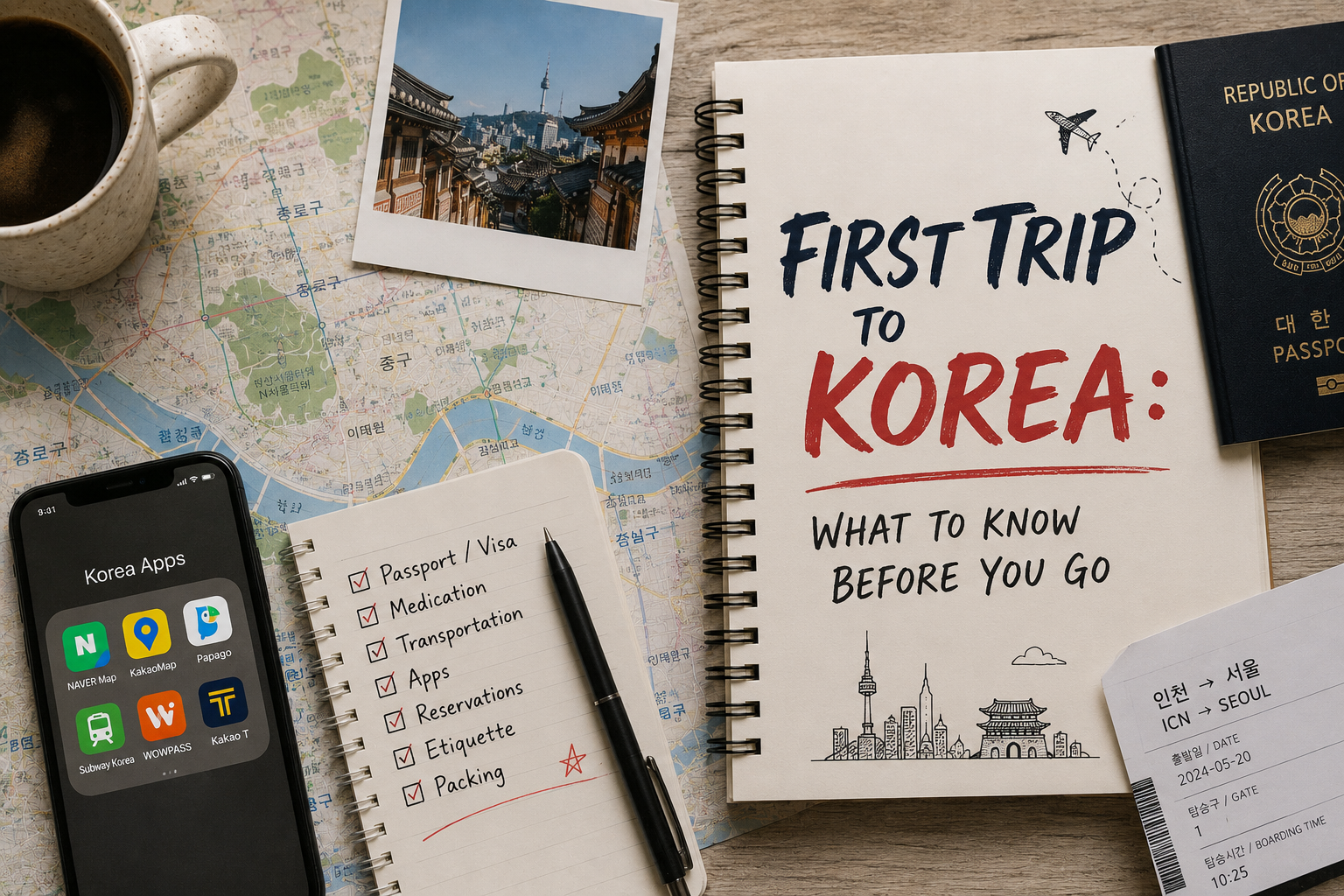
Planning your first trip to Korea? Here are the things I recommend preparing before you leave, based on what I’ve learned from my own trips to Korea.
You don’t need to plan every minute of your trip or pack everything you might possibly need. Focus on the things that are difficult to arrange after you arrive, and leave some room for spontaneity.
Here’s a practical order I recommend following before your first trip to Korea.
1. Prepare Your Important Documents First
Once your flight and accommodation are booked, start with the documents you will need during your trip.
Make sure you have:
- A valid passport
- Visa or entry documents, if required
- Flight information
- Accommodation confirmation
- Travel insurance information
- Credit or debit cards
- A small amount of Korean won
- A copy of your passport
Check your passport expiration date before traveling. Many international travelers prefer to have at least six months of validity remaining, but the actual requirement can vary depending on your nationality and circumstances. Check the current Korean entry requirements that apply to you before you leave.
You should also check whether you need a visa or K-ETA. Korea allows visa-free entry for eligible travelers from many countries, but the permitted stay and other requirements vary by nationality.
Because entry rules can change, always check the latest official information before your trip.
I also recommend keeping a paper copy of your passport and important reservations. You may never need them, but if your phone battery dies or you have trouble accessing the internet, having a backup can be useful.
2. If You Take Prescription Medication, Prepare It Early
This is something I personally pay close attention to because I take medication every day.
Before traveling, I make sure I have enough medication for the entire trip. I also keep information about my medical condition and prescriptions with me in case I unexpectedly need medical attention.
If you take prescription medication, bring your prescription or medical documentation together with your medication.
Some medications may be subject to regulations when entering Korea. Having documentation that explains what the medication is and why you need it can be helpful if questions arise.
You may want to prepare:
- Enough medication for your entire trip
- Your prescription
- A list of the medications you take
- Information about your medical condition
- Medical documentation, preferably in English when possible
- Information that could help a doctor understand your situation
Keep your medication and related documents somewhere easily accessible.
Also, check the current Korean regulations for your specific medication before you travel. Certain prescription or controlled medications may have additional requirements for bringing them into Korea.
Don’t assume that a medication you can legally take in your home country can automatically be brought into Korea without additional requirements.
3. Plan Your Main Travel Route
Before filling your schedule with restaurants and sightseeing spots, decide how you will move between cities and neighborhoods.
For example:
Seoul → Busan → Gyeongju → Seoul
Start with the bigger picture first, then plan the details.
Once you know your main route, choose the attractions, neighborhoods, and restaurants you want to visit along the way. You don’t need to plan every minute of your trip. Grouping places that are close to each other can save you a lot of time.
Korea’s Public Transportation Makes Traveling Easier
One of the advantages of traveling in Korea is its extensive public transportation system.
In major cities such as Seoul and Busan, subway and bus networks connect city centers, tourist attractions, residential neighborhoods, and areas away from major subway stations. Local and town buses can also take you into smaller neighborhoods and streets that are not directly connected to the subway.
This means you often don’t need to rent a car just because your destination is not next to a subway station.
For many travelers, a combination of subway, bus, and walking is enough to get around comfortably.
Seoul Metropolitan Government – Public Transportation Guide
Give Yourself Extra Time for Traffic
One thing first-time visitors sometimes underestimate is traffic.
Seoul and Busan can have heavy traffic, especially during busy periods. A destination may look relatively close on a map, but the actual journey can take longer because of traffic, transfers, walking, or waiting time.
So when planning your route, leave some extra time between activities.
This is especially important if you have a restaurant reservation, tour, or train to catch.
The travel time shown on a map is not always the total time you will actually need. Give yourself extra time to find subway exits, walk to your destination, transfer between lines, and deal with unexpected delays.
Check Restaurants Before You Go
If there is a popular restaurant you really want to try, check whether it accepts reservations before your trip.
Some restaurants can be very busy, and making a reservation in advance can save you from a long wait or missing out altogether.
You don’t need to reserve every meal. Just check ahead for the places you especially want to visit.
4. Download and Test the Apps You Actually Need
You don’t need to download every Korea travel app you find online.
Start with a few useful apps and add others based on your itinerary.
NAVER Maps
NAVER Maps is useful for finding places, checking walking routes, and planning subway and bus journeys.
KakaoMap
KakaoMap is another useful map option for finding places and checking public transportation.
You don’t necessarily need both. NAVER Maps may be enough for many travelers, but having another option can be useful.
Papago
Papago can be especially useful when you need to translate Korean. It can translate text, voice, and images, which can be helpful when reading menus, signs, or other Korean information.
Google Translate
Google Translate is also worth keeping on your phone, especially if you already use it regularly.
Having a second translation option can be useful when one translation doesn’t give you the result you expected.
Seoul Subway
If you plan to use the Seoul subway, the official Seoul Subway app can help you check routes, transfers, stations, real-time train information, and other subway details in English.
You Don’t Need to Be Afraid of the Language Barrier
If you’re worried about traveling in Korea because you don’t speak Korean, don’t be too nervous about it.
Many subway stations and public facilities provide information in English, especially in major transportation areas and tourist destinations.
Not everyone in Korea speaks fluent English, but many Koreans can communicate in simple English, particularly in everyday situations involving visitors.
You may still come across places where English isn’t available, especially in smaller towns or local businesses. That’s where a translation app can help.
You don’t need to speak Korean fluently to travel around Korea. A translation app, a little preparation, and some patience can go a long way.
5. Reserve Transportation That Can Be Booked in Advance
After deciding where you’re going, check which transportation options can be reserved ahead of time.
Depending on your itinerary, this might include:
- KTX
- SRT
- Express buses
- Airport transportation
You don’t need to reserve every bus or subway ride.
For longer trips, such as traveling from Seoul to Busan, deciding on your transportation in advance can make the rest of your itinerary easier to organize.
6. Make a Short Note About Korean Etiquette
You don’t need to memorize a long list of Korean customs before your trip.
Just make a short note about a few things that may be different from what you’re used to.
For example:
- Basic public transportation etiquette
- Priority seating
- Taking off your shoes in certain places
- Basic restaurant etiquette
- Tipping in Korea
- Behavior in public spaces
The goal isn’t to become an expert on Korean culture before you arrive.
It’s simply to understand a few everyday customs so you know what to expect.
7. Don’t Overpack
One of my personal travel habits is to leave plenty of room in my suitcase when I go to Korea.
I don’t usually pack a lot of clothes or beauty products before leaving.
Korean cosmetics and personal-care products are easy to find in Korea, and there are so many options that I often prefer to buy what I need after I arrive.
The same goes for clothing. Korean clothing can be stylish, practical, and reasonably priced, so if I need something during my trip, I can simply buy it there.
Because of that, I usually pack only the essentials and leave plenty of empty space in my luggage.
And somehow, every time I come back from Korea, that empty space is gone. My suitcase always seems to come home completely full.
So don’t feel like you need to pack everything before your trip.
Many everyday items can be purchased easily in Korea if you need them.
For example, you probably don’t need to pack a large umbrella just because it might rain. If you need one, you can easily buy one locally.
Pack what you really need, leave some room in your suitcase, and buy the rest when necessary.
You may be surprised by how useful that extra space becomes on the way home.
8. Save Important Information Offline
Before leaving home, do one final check.
Save important information somewhere you can access without an internet connection, such as screenshots or offline files.
Consider saving:
- Your accommodation address
- Flight information
- Hotel reservation
- Transportation reservations
- Travel insurance information
- Passport copy
- Emergency contacts
- Medical information
It’s a small step, but it can be extremely useful if your phone loses its connection or your battery runs low.
Before You Leave: Quick Checklist
☐ Passport and entry requirements
☐ Prescription medication and medical documents
☐ Main travel route
☐ Attractions and restaurants
☐ Extra time for traffic and transfers
☐ Essential apps downloaded and tested
☐ Important transportation reserved
☐ Basic Korean etiquette reviewed
☐ Unnecessary luggage removed
☐ Important information saved offline
☐ Leave some extra space in your suitcase
You don’t have to prepare everything perfectly before your first trip to Korea.
The goal is simply to take care of the things that are difficult to solve after you arrive and leave the flexible things for later.
Plan the important parts, give yourself extra time, pack light, and leave some room in your suitcase.
You might just come home with a suitcase much fuller than the one you left with.