I currently live in the U.S., but I have kept my Korean Silson insurance for years. I pay about $26 a month, and over time, I’ve had a few experiences that made me realize how useful this type of insurance can be.
One of my smaller claims involved prescription medication and medical expenses totaling around $26. I paid the bill first, collected the necessary documents, and submitted the claim to my insurance company. After reviewing the claim, the company reimbursed the eligible amount directly into my bank account, after deducting about $6 for the deductible.
I’ve also had a much larger medical expense after undergoing major surgery in Korea. I received several hundred dollars in reimbursement through my Silson insurance. I would need to look through my older records to confirm the exact amount, but I remember that the reimbursement was genuinely helpful at the time.
Those experiences are probably the best way for me to explain why I’ve continued to keep the insurance.
What Is Silson Insurance?
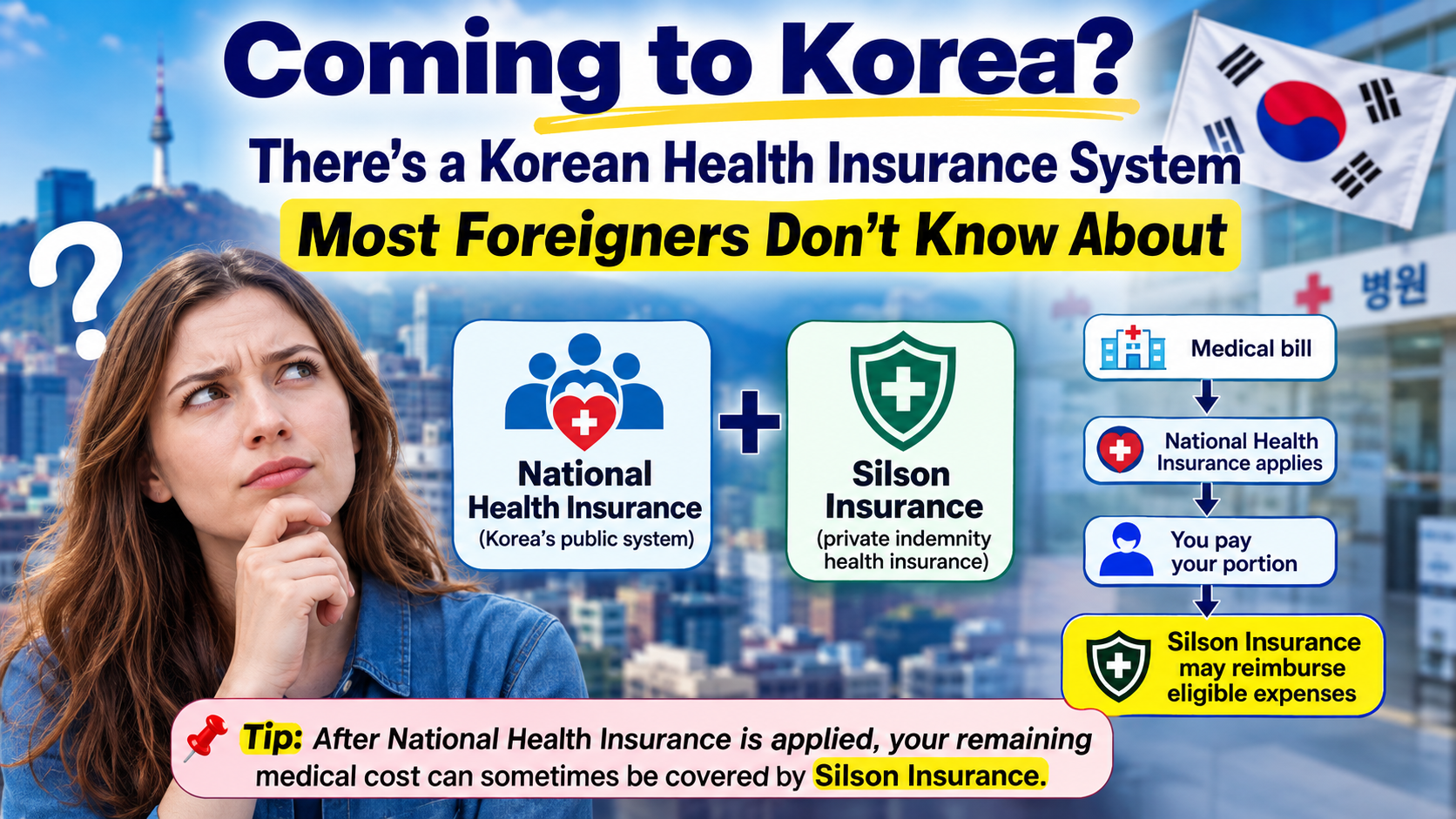
Silson insurance, or Silson Uiryo Boheom , is a type of private indemnity health insurance in Korea.
It works alongside Korea’s National Health Insurance, rather than replacing it.
National Health Insurance is the country’s public healthcare insurance system. Even after National Health Insurance covers its portion of a medical expense, patients may still have out-of-pocket costs.
Depending on the policy, Silson insurance can reimburse part of those eligible expenses.
In simple terms, you generally pay for your medical care first and then submit a claim for eligible expenses.
It is not a system where every medical bill is automatically paid by private insurance, and the amount you receive depends on your individual policy.
How Korean Silson Insurance Claims Work
When I first used Korean Silson Insurance, filing a claim involved collecting receipts and medical documents and sending them to the insurance company.
The process is now much easier.
Korea has introduced Silson24, an electronic insurance-claim system that allows eligible policyholders to submit claims online through the Silson24 website or app.
For participating medical institutions, documents such as medical receipts, detailed statements, and prescriptions can be electronically transferred to the insurance company.
The Financial Services Commission expanded electronic insurance claims to clinics and pharmacies on October 25, 2025. As of April 1, 2026, 29,849 medical institutions were connected to the Silson24 system, allowing eligible patients to submit insurance claims electronically without visiting a hospital in person. Financial Services Commission of Korea – Silson24 Electronic Claims
The basic process is:
Receive treatment → Pay the medical bill → Submit the claim → Insurance company reviews it → Reimbursement is deposited into your account
That convenience is one of the things I find particularly interesting about the Korean system.
What Does Silson Insurance Cover?
Coverage depends heavily on the policy.
Some plans have deductibles, coverage limits, exclusions, and different rules for inpatient and outpatient treatment.
Korea also has non-covered medical services, known as bigeupyeo (비급여). Whether these expenses are reimbursed depends on the specific policy.
This is also why it is important to check the actual terms of your insurance rather than assuming that someone else’s Silson policy will work the same way.
Silson insurance has gone through several generations over the years, and coverage structures have changed. Policies commonly referred to as first-, second-, third-, fourth-, and fifth-generation Silson insurance can have different premiums, deductibles, and coverage rules.
The fifth generation was introduced in 2026, with changes to the way certain medical services and non-covered treatments are handled.
Can Foreigners Get Silson Insurance?
Foreign residents in Korea can be eligible for private indemnity insurance, but eligibility is not automatic.
Insurance companies have their own requirements, and factors such as visa or residency status, registration, length of stay, and individual circumstances may affect eligibility.
So the answer isn’t simply “yes, every foreigner can get it.” A better way to put it is that foreign residents may be able to obtain Silson insurance if they meet the insurer’s requirements.
Foreign residents can also be eligible for private indemnity health insurance in Korea under certain conditions. For example, Sookmyung Women’s University officially requires international students holding a D-2 visa to enroll in private indemnity health insurance. The university explains that the insurance provides coverage for certain medical expenses not covered by Korea’s National Health Insurance. Sookmyung Women’s University – Private Indemnity Insurance for International Students
Anyone interested should check the current eligibility requirements directly with an insurance company.
How Much Does It Cost?
My current premium is about $26 per month, but this is only my personal experience.
Silson insurance premiums can vary depending on factors such as age, the date the policy was purchased, the generation of the policy, coverage, and individual circumstances.
The amount I pay should not be treated as a standard price.
For me, however, the monthly cost has felt worthwhile because I’ve actually received reimbursements when I had medical expenses.
Looking at Korean Healthcare From the U.S.
Living in the U.S. has made me notice things about Korean healthcare that I probably took for granted when I lived there.
I’m not saying that the Korean healthcare system is perfect or that it is better than the U.S. system in every way. Healthcare is complicated, and both countries have their own strengths and challenges.
But having used Korean healthcare and Silson insurance myself, I think the system is worth understanding, especially for people outside Korea who may not be familiar with it.
What stands out to me most is the combination of National Health Insurance and private coverage(Silson Insurance)
The public system provides the foundation, while private insurance can provide additional financial protection for certain eligible expenses.
For me, that protection has been useful enough to make keeping my policy worthwhile.
If you’re researching healthcare in Korea, understanding how National Health Insurance and Silson insurance work together is a good place to start.
This article is based partly on my personal experience and is intended for general informational purposes only. It is not insurance or financial advice. Eligibility, premiums, coverage, deductibles, exclusions, and reimbursement depend on the individual policy, personal circumstances, and current regulations. Dollar amounts are approximate conversions for readers’ convenience and may vary with exchange rates.