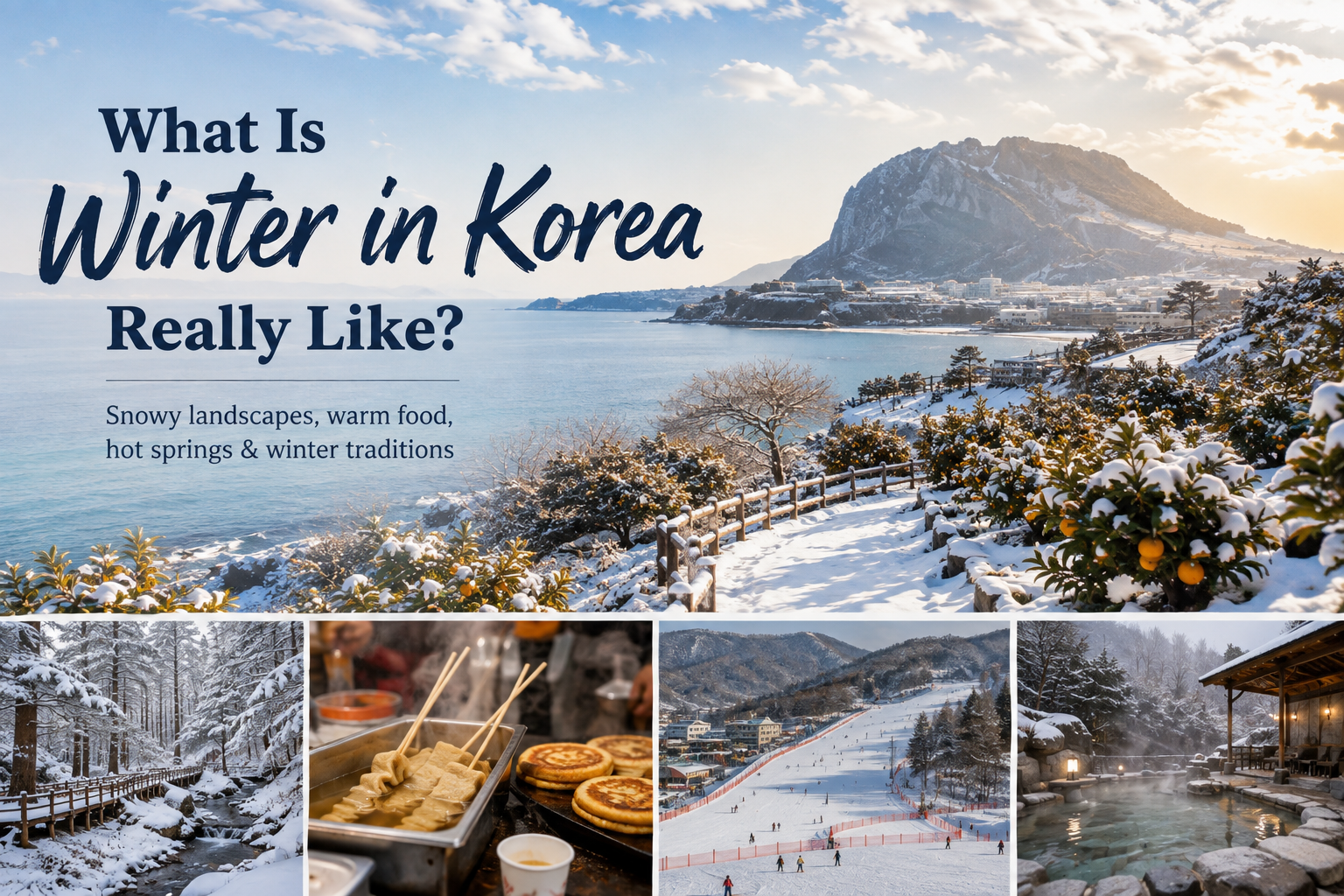
Winter in Korea can be brutally cold—but it can also be surprisingly warm.
When I think about Korean winters, I remember standing beside a small street food cart with a cup of hot eomuk broth warming my hands while waiting for a freshly made hotteok.
I remember hearing vendors call out “Chapssaltteok!” through the neighborhood at night and occasionally buying the chewy rice cakes as a late-night snack.
I also remember sledding down frozen neighborhood hills with friends and following my parents to hot springs and jjimjilbangs.
Those memories taught me something about Korean winter:
The cold is only half the story.
From snowy mountains and winter sports to steaming street food, traditional tea, hot springs, and Christmas lights, Korea has a completely different atmosphere when temperatures drop.
What Does Winter Feel Like in Korea?
Winter changes the mood of the country.
The streets become filled with steaming food stalls, and you can often see clouds of steam rising from restaurants and street vendors. Instead of looking for something cold to drink, people naturally start looking for something warm.
Hot eomuk broth, hotteok, roasted sweet potatoes, and bungeoppang become familiar winter treats.
As Christmas approaches, busy shopping areas and city streets begin to glow with Christmas trees, lights, and seasonal decorations. You may hear Christmas songs playing in shopping districts, while the ringing of charity kettles adds another familiar sound to the holiday season.
But Christmas is only part of the winter atmosphere.
The end of the year is also a busy time in Korea. People meet friends and family, arrange year-end dinners, prepare for the New Year, and send messages of appreciation to people around them.
So although the weather becomes colder, Korean cities can feel surprisingly lively.
Warm Street Food and Traditional Tea
If you visit Korea in winter, don’t be surprised if food becomes part of your sightseeing.
Eomuk, Korean fish cake served with hot broth, is one of the simplest ways to warm up on a cold day.
Then there is hotteok, a sweet Korean pancake usually filled with brown sugar, cinnamon, and nuts.
You may also find bungeoppang, fish-shaped pastries filled with red bean paste or custard, and roasted sweet potatoes sold from street carts.
And if you happen to hear someone calling “Chapssaltteok!” on a winter evening, you may have found one of those old-fashioned Korean winter memories that still survives in some places.
Winter is also a good time to try traditional Korean tea.
Ginger tea, citron tea, jujube tea, and cinnamon tea are commonly enjoyed hot during the colder months.
And you don’t necessarily have to find a traditional tea house.
Korea has countless large and small coffee shops, and many cafés introduce seasonal winter drinks using familiar Korean flavors. You may find drinks inspired by citron, ginger, sweet red bean, or other traditional ingredients alongside coffee and hot chocolate.
If you see one on the menu, give it a try.
It is an easy way to experience a little Korean food culture during an ordinary café stop.
VisitKorea — Korean Tea & Traditional Food Culture
Snowy Korea Looks Completely Different
Korea’s landscapes change dramatically with the seasons, and winter has a beauty of its own.
Seoraksan is especially impressive after snowfall. The mountains can look completely different from the way they appear in spring, summer, or autumn.
But one of my most unforgettable winter landscapes was on Jeju Island.
A few years ago, I was driving around Hallasan in winter when I came across a scene I still remember vividly. The trees were covered in layers of white frost and ice, almost as if delicate white flowers had suddenly bloomed across the branches.
I remember being amazed by how quiet and beautiful everything looked. It was completely different from the green landscapes I had seen on Jeju during warmer seasons.
That winter scenery around Hallasan is still one of my favorite memories of Korea, and I would definitely recommend experiencing Jeju in winter if you have the opportunity.
You don’t have to climb Hallasan to appreciate the scenery. Even driving around the mountain area can reveal beautiful winter landscapes, depending on the weather and road conditions.
That experience reminded me that Korea can show you something completely different depending on the season. The same mountain and landscape can feel like an entirely different place when winter arrives.
VisitKorea — Hallasan National Park & Jeju Travel Information
Sledding and Skiing
If you want to do more than admire the snow, Korea has plenty of winter activities.
For families and travelers who don’t ski, sledding is one of the easiest options. Seasonal sledding areas are available in Seoul and other parts of the country, although opening dates can change each year.
For skiing and snowboarding, Gangwon State is one of Korea’s main winter destinations.
Resorts such as Yongpyong, Vivaldi Park, and High1 are among the better-known options. Some resorts also offer restaurants, cafés, accommodation, and other activities, so you don’t have to be a serious skier to enjoy a winter day there.
And after spending time outside in the cold, a warm churro, hot chocolate, or bowl of steaming food can be just as memorable as the snow itself.
VisitKorea — Ski Resorts & Winter Travel in Korea
Jjimjilbang: A Korean Way to Warm Up
One of my favorite things about Korean winter is that there are so many ways to escape the cold without leaving the country.
A jjimjilbang is a Korean-style sauna and relaxation facility where people can bathe, use heated rooms, rest, eat snacks, and spend several hours relaxing.
For me, jjimjilbangs are connected to childhood memories of following my parents to bathhouses during winter.
For a first-time visitor, they can also be an interesting way to experience a part of everyday Korean culture.
In Seoul, you can find both traditional-style sauna facilities and large modern jjimjilbangs.
Just remember that the bathing areas are generally separated by gender, while the communal jjimjilbang areas are shared.
Hot Springs in Seoul, Busan, and Jeju
Korea also has a long tradition of oncheon, or hot springs.
I remember going to hot springs in Seoul with my parents when I was young. At the time, it simply felt like something families did on a cold winter day.
Whenever I visited Busan, I also enjoyed the Haeundae area, which has long been associated with hot springs and is now one of the city’s best-known tourist areas.
For a larger modern spa experience, Spa Land Centum City in Busan is another option.
But one of my more recent winter memories came from Jeju.
Sanbangsan Carbonate Hot Spring
During the winter of 2025, I visited Sanbangsan Carbonate Hot Spring in Jeju.
What makes it interesting is its carbonated hot spring water and outdoor bathing areas.
Being in warm water while surrounded by cool winter air and Jeju’s landscape felt completely different from visiting a spa in the city.
There are also outdoor pools and other facilities, making it a place where families can spend several hours or even much of the day.
For visitors looking for a relaxing winter experience in Jeju, I think it is worth considering, especially if you are traveling with family.
VisitKorea — Sanbangsan Carbonate Hot Spring
Christmas, Winter Festivals, and the New Year
Winter in Korea becomes especially lively toward the end of the year.
Christmas lights appear in busy areas, shopping districts become more colorful, and seasonal events take place in different parts of the country.
Depending on the year, you may also find winter festivals featuring snow, ice, sledding, fishing, food, and local traditions.
Pyeongchang and other regions of Korea are known for winter activities, while different cities and towns host their own seasonal events.
Because festival schedules and operating dates change from year to year, always check the official tourism or event website before making a specific plan.
VisitKorea — Korea Winter Travel Information
A Different Kind of Warmth
Korean winter is cold, but that doesn’t mean the season feels empty or quiet.
There is something happening everywhere—from brightly lit streets and year-end gatherings to winter food stalls, snowy mountains, hot springs, and seasonal activities.
What makes winter special is the contrast.
Cold air outside, warmth inside.
Snow-covered mountains and steaming food.
Quiet winter landscapes and busy city streets.
If you have only experienced Korea during spring, summer, or autumn, winter is worth seeing for yourself.
You may discover a side of Korea that feels completely different from the one you expected.
Korea in winter isn’t simply a place to escape the cold. It’s a place to discover a different kind of warmth.