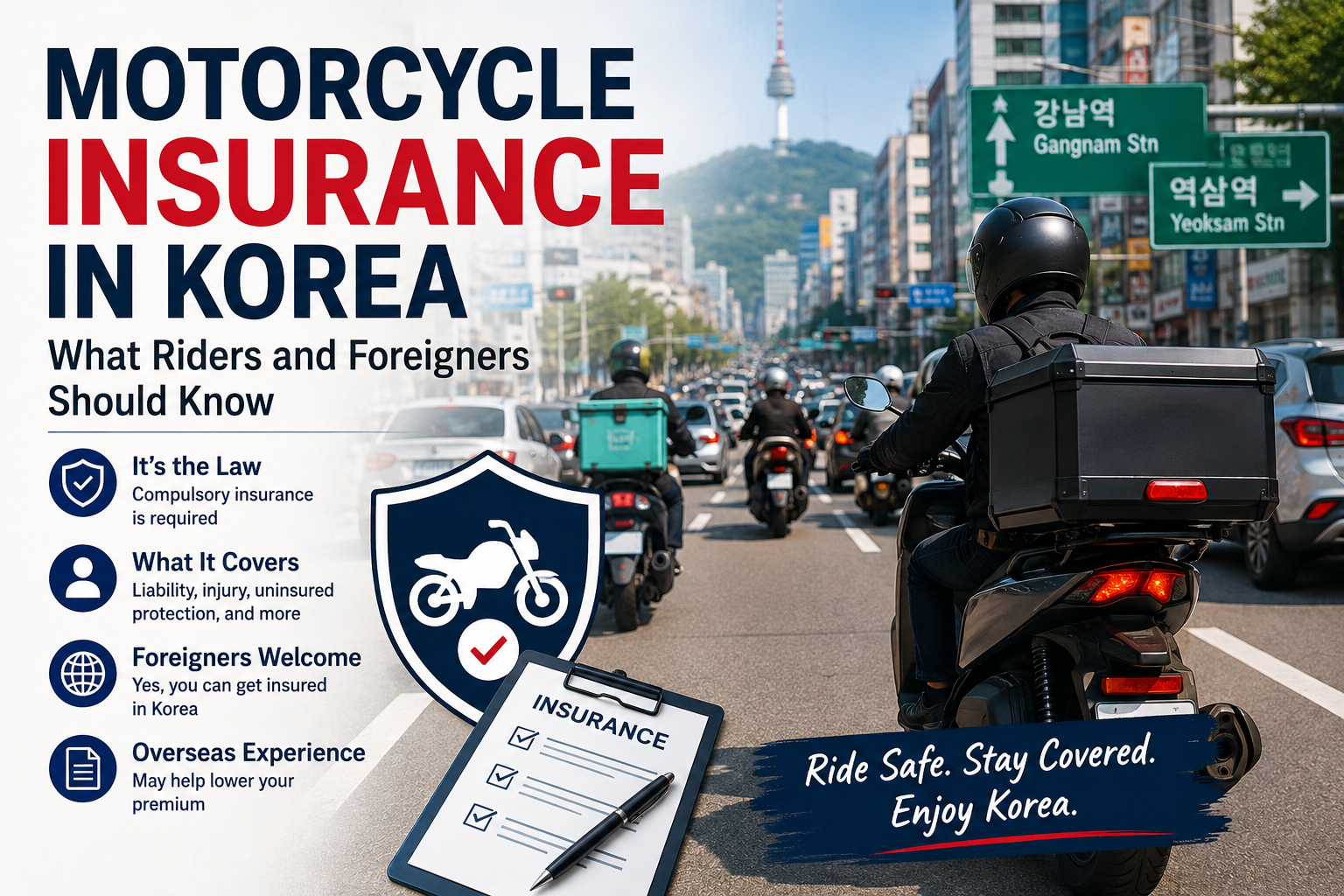
If you spend time in any of Korea’s major cities, one thing is hard to miss: motorcycles.
In Seoul, Busan, and Incheon, delivery scooters move through busy streets all day, slipping between cars and navigating narrow side roads. Korea’s fast-growing delivery culture has made motorcycles an even more familiar part of everyday traffic.
Then the weekend comes. Head just outside Seoul, and you’ll often see another side of motorcycle culture — groups of riders heading toward the hills, rivers, and winding roads outside the city.
With so many motorcycles sharing the road with cars, small accidents can happen. A mirror gets clipped. A scooter bumps into a car while moving through a tight space. A motorcycle goes down and damages another vehicle.
That made me wonder about something I hadn’t really thought about before: when a motorcycle is involved in an accident in Korea, how does the insurance actually work?
The answer is a little different from what someone unfamiliar with Korea might expect.
Motorcycle Insurance Is a Separate Category
In Korea, motorcycles are covered under a separate category of insurance commonly called — motorcycle or two-wheeler insurance.
It isn’t simply an extension of your passenger-car policy. If you own both a car and a motorcycle, you generally need to look at the insurance for each vehicle separately.
The basic idea is similar to car insurance, though. Some coverage is designed to compensate other people when you cause an accident, while other coverage can protect you or your motorcycle.
Korean government guidance describes motorcycle insurance within the broader automobile insurance system and distinguishes between mandatory liability coverage and additional coverage options.
What Happens If You Ride Without Required Insurance?
This is the part I wouldn’t take lightly.
Korean law requires applicable vehicles to have compulsory liability insurance. The purpose isn’t simply to protect the motorcycle owner. It helps ensure that someone injured or whose property is damaged in a traffic accident has a way to seek compensation.
Riding without the required insurance can result in administrative penalties, and operating an uninsured vehicle can also have more serious legal consequences under the relevant law.
So insurance isn’t something I’d leave until after buying the motorcycle. It’s one of the first things I’d check.
Motorcycle Insurance Can Cover More Than the Motorcycle
This was probably the most useful thing to understand.
Motorcycle insurance isn’t necessarily just about repairing your own bike.
Depending on the policy, coverage can include:
- Bodily injury liability — compensation when you injure another person in an accident, within the statutory limits.
- Additional bodily injury liability — coverage that can extend beyond the limits of mandatory bodily injury coverage.
- Property damage liability — damage you cause to another person’s car, motorcycle, building, or other property.
- Coverage for your own injuries — depending on the policy, protection for injuries to the insured.
- Uninsured-motorist injury coverage — protection when you’re injured by an uninsured vehicle, subject to the policy terms.
- Own motorcycle damage — coverage for damage to your own motorcycle when this option is included.
These aren’t all automatically included in every policy. Some are mandatory liability coverage, while others are optional protections. Korean government guidance lists these coverage categories and explains what each is designed to cover.
That distinction matters. A policy can look inexpensive because it contains only the required coverage, while another may cost more because it includes additional protection.
Your Motorcycle’s Use Matters
There’s another detail worth paying attention to: how you use the motorcycle.
A motorcycle used for personal transportation isn’t treated the same way as one used for paid delivery work. Korean financial authorities have specifically addressed insurance for motorcycles used for paid transportation and delivery, where risk and insurance costs can be different.
So if you’re using a motorcycle for delivery or another commercial purpose, it’s important to tell the insurer honestly when purchasing the policy.
Choosing a personal-use classification simply because it is cheaper can create problems when you actually need to make a claim.
Can Foreigners Get Motorcycle Insurance in Korea?
Generally, yes.
Foreign residents who meet an insurer’s requirements can apply for motorcycle insurance in Korea. Before contacting an insurer, it is useful to have your Alien Registration Card, Korean motorcycle driver’s license or other valid driving credential, and motorcycle registration information ready.
The exact documentation can vary depending on the insurer and the applicant, so I would confirm the requirements before starting the application.
For someone coming from another country, this is one area where a little preparation can make the process much easier.
What If You Have Driving or Insurance History Overseas?
This is an especially useful question for foreign residents.
Korea has a system that can recognize certain previous driving and insurance experience when determining automobile insurance premiums. In 2024, the Financial Services Commission expanded and clarified recognition of several types of driving history, including overseas automobile insurance history. Documents such as an overseas insurance certificate and proof of entry and exit may be required.
However, I wouldn’t assume that having overseas motorcycle experience automatically guarantees a discount on a Korean motorcycle policy.
Recognition can depend on the insurer, the type of previous insurance, and the documentation provided. If you have insured a motorcycle overseas before, it’s worth asking the Korean insurer whether that history can be recognized before the policy is finalized.
If they request supporting documents, you may need things such as:
- An official insurance history or coverage certificate
- Previous policy documents showing the motorcycle coverage
- A claims or no-claims history, if available
- Documents confirming your identity and the period you were insured overseas
The important part is to ask before the premium is finalized, rather than assuming the history will be recognized automatically.
Don’t Just Compare the Cheapest Premium
This is probably the biggest practical lesson.
When comparing motorcycle insurance in Korea, the lowest premium isn’t necessarily the best deal.
Look at what is actually included — particularly bodily injury liability, property damage liability, protection for your own injuries, uninsured-motorist coverage, and damage to your own motorcycle when available.
Two policies can have very different levels of protection even when the price difference initially looks small.
For me, that is the bigger lesson behind Korea’s motorcycle insurance system.
The motorcycle itself is only part of the picture. The more important question is what happens to you, another person, another vehicle, or someone’s property when something goes wrong.
And with motorcycles becoming such a visible part of Korean traffic, that’s something worth understanding before you ride.